


Interview: Edouard Demachy and Thomas Tardif

This week, we met Edouard Demachy and Thomas Tardif, two complementary antiques dealers with a keen eye, for whom the antique trade is part of a tradition of knowledge transmission, but also in new issues of sustainable development.
What is your speciality ?
We choose objects that have been created during the last 100 years, always with the thread of the modernist spirit. We sweep all periods, we can have Art Deco or Art Nouveau, if they have a modern line or we find intelligent in terms of construction Thanks to the experience, the look is refined and becomes precise We have a very sharp selection and can see hundreds of pieces before investing
Regarding our areas of expertise, Edouard is the ceramic and Thomas furniture We are often attracted by objects that we do not know and we like to do the research and documentation work to expand our knowledge and sharpen our " eye ", our judgment We are very attentive to the state of a piece that interests us, at its level of restoration
How do you envision your antique trade?
We are in a perspective of knowledge transmission We like to initiate and sensitize all audiences, there is no typical customer, we reserve the same welcome to all We invite visitors to take the objects in hand We have the role of to satisfy the curiosities, this is inherent to the survival of our profession To transmit the knowledge, it is to give the taste and the envy
A second important point for us is the relationship between our business and sustainable development It is a subject that is dear to us and that we do not hesitate to put forward The issue is so important that we also like to remind customers We sell objects with a lifespan that will go well beyond we and we love this idea
How did you both associate?
Initially, we each owned our space and we already made joint purchases Today, we share the same stand We are two entities gathered in one with each one his freedom of decision, action, purchase and taste Of course we did not associate by chance, we have a common guideline with complementary specialties The difference of our points of view is sometimes a force because if one can be carried on a piece, the other is able to moderating it We always go in the direction of the one who expresses doubts
What do you like about Paul Bert Serpette?
Being installed in Serpette, that is to say in a closed environment and without daylight allows us to create atmospheres and to highlight certain aesthetics This allows us to sublimate objects
What is also interesting to Paul Bert Serpette, is that every Friday, we are in contact with the professionals of the sector This meeting of different profiles of merchants creates a real effervescence around the knowledge and the knowledge, because we exchange a lot between us Paul Bert Serpette drains all the great Parisian and international merchants It's a cradle for the merchandise, a lot of objects that are currently in gallery have passed by here, we are an essential source Paul Bert Serpette is today the largest antique market in the world. There is a much greater customer density than in a gallery, here there are always people and the contact is easier because there is no obstacle to the door to push
Do you have a piece of your booth that you want to highlight?
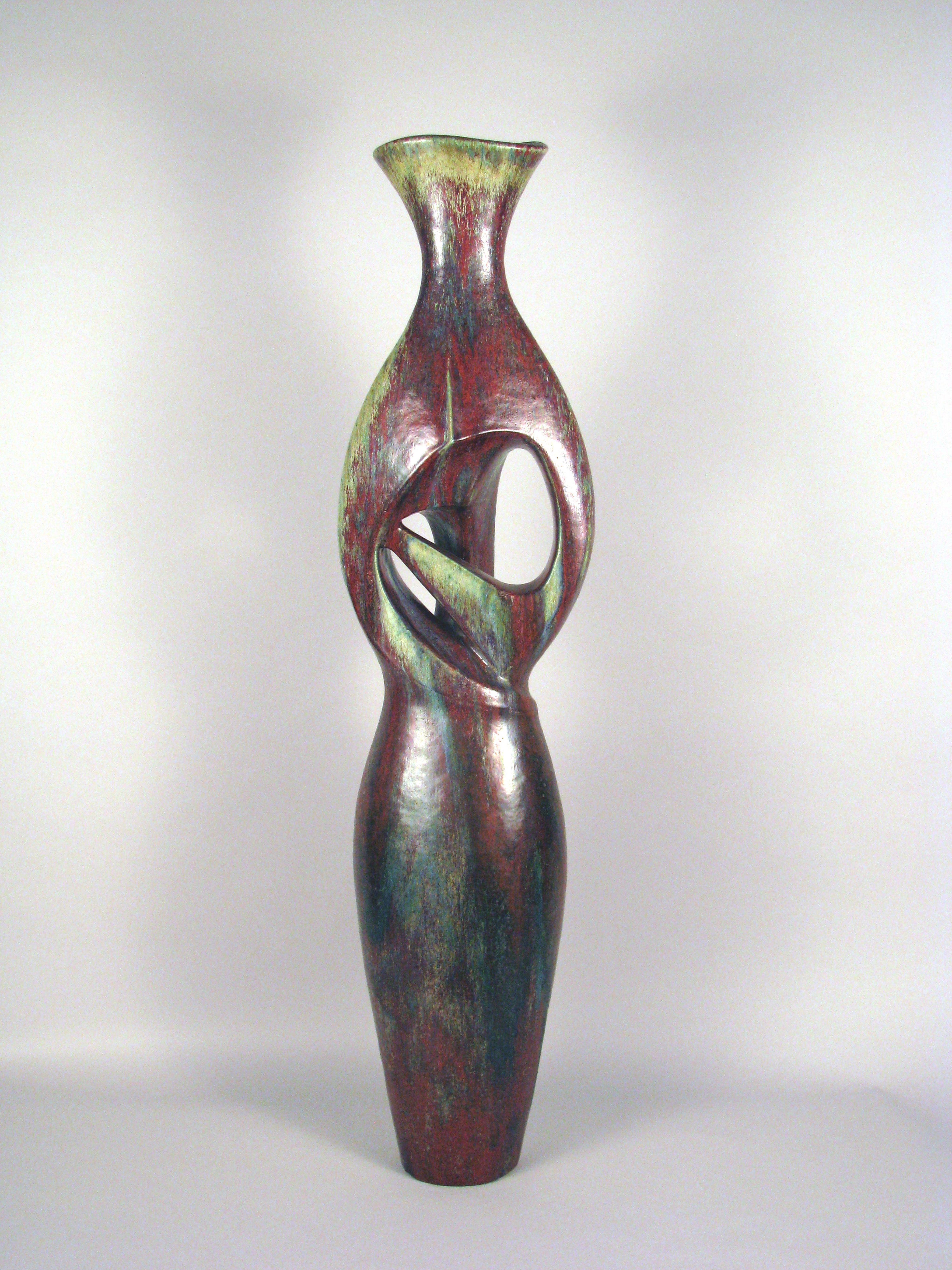
We have a large ceramic vase on which we have done a lot of research It is a very large piece, it is 113 cm A lot of time has been spent deciphering the signature It was made in Belgium, it comes from a historical factory called "Boch Frères" in La Louvière This is a piece which, due to its architectural and anthropomorphic qualities, can be dated from the 50's The covered is in enamel known as beef blood, which is characteristic of some artists of the Art Nouveau era as Pierre-Adrien Dalpayrat We have this representative cover of early 1900, a characteristic form of the 50s and a signature of this Belgian factory By doing research, we made a discovery We found a commemorative plate which dates from 1954 on which two pieces are drawn, including a vase that looks very strangely similar to ours We therefore think that on the occasion of the comm moration the commissioning of a furnace in 1954, the factory had to call a number of potters, and this piece is an exceptional format would come to the inauguration of the oven
It's a purchase that illustrates our line, and the way we work