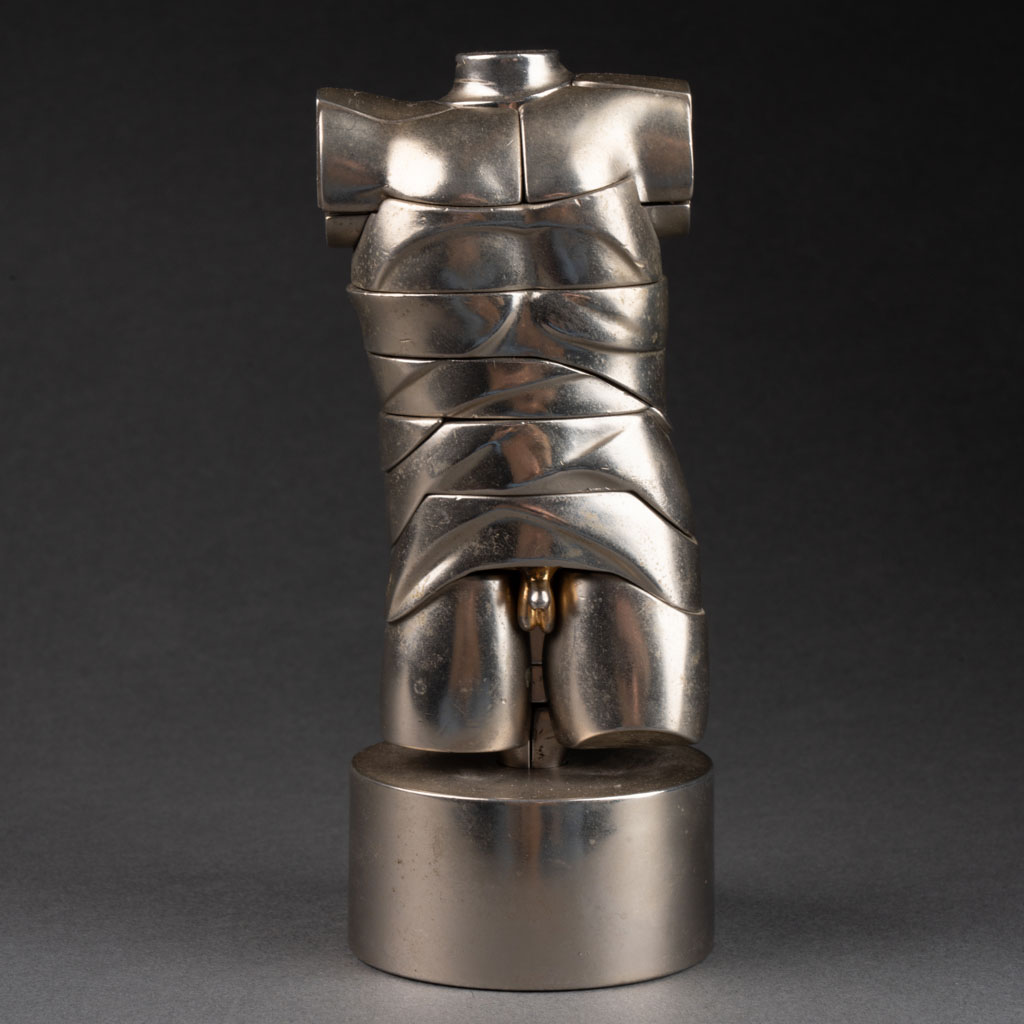
<p>Born in 1933 in Villanueva de Algaidas, near Malaga, Miguel Berrocal is one of the most innovative Spanish sculptors of the 20th century. With a background in mathematics, chemistry, exact sciences and architecture, he was able to combine his love of art with his scientific knowledge. From the 1950s onwards, Berrocal exhibited his works throughout Europe, quickly building a reputation for his intriguing and interactive sculptures…</p><p> Berrocal is best known for his “puzzle sculptures,” modular works composed of multiple detachable pieces. These sculptures, which can be disassembled and reassembled, invite the viewer to physically interact with the work, transforming the passive observer into an active participant. This approach makes his art deeply engaging and accessible, blending aesthetics with intellectual exploration.</p><p> Works such as <em>Mini-David</em> (1970) or <em>Richelieu</em> perfectly illustrate this philosophy. <em>Mini-David</em> , inspired by Michelangelo's David, is composed of several pieces that come together to reveal a geometric silhouette. This combination of art and mechanics offers a unique experience, where the manipulation process becomes an extension of the work itself.</p><p> The scientific precision of Berrocal’s sculptures reflects his ability to combine art and technique. Using primarily materials such as bronze and aluminum, he designs each work with architectural meticulousness, creating pieces that fit together perfectly. His creations are as much puzzles to be solved as they are art objects to be contemplated.</p><p> Among his iconic works, <em>Il Cofanetto</em> (Opus 123) stands out for its complexity. This sculpture, in homage to Romeo and Juliet, can be disassembled into 88 pieces that form a complete table service. This fusion of aesthetics and functionality illustrates Berrocal's unique vision, where art transcends its traditional boundaries.</p><p> Despite their technical complexity, Berrocal’s works never lack emotion. His sculptures explore universal themes such as transformation, movement and the relationship between the human body and space. For example, his fragmented torsos or his interlocking human figures reflect a profound reflection on the human condition and the passage of time.</p><p> Berrocal has exhibited at prestigious institutions such as MoMA in New York, the Centre Pompidou in Paris and the Venice Biennale. His influence extends beyond the art world, inspiring the fields of design and engineering. The Berrocal Foundation, established in Malaga, perpetuates his legacy by preserving and exhibiting his works.</p>