


Emile Gallé, Vase Repos dans la Solitude, 1900
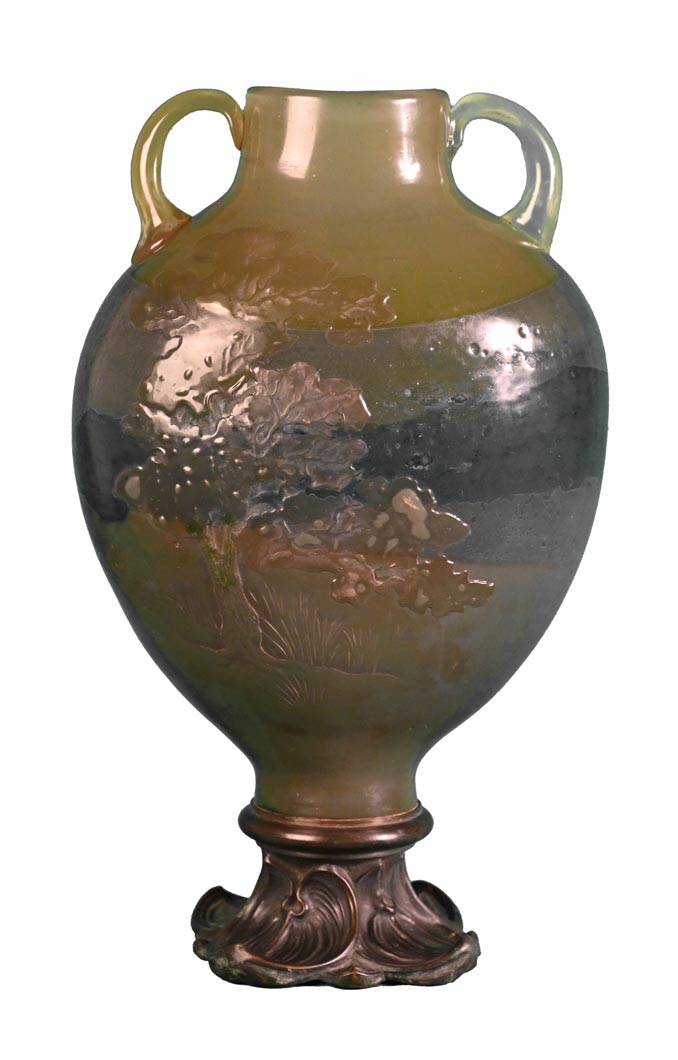
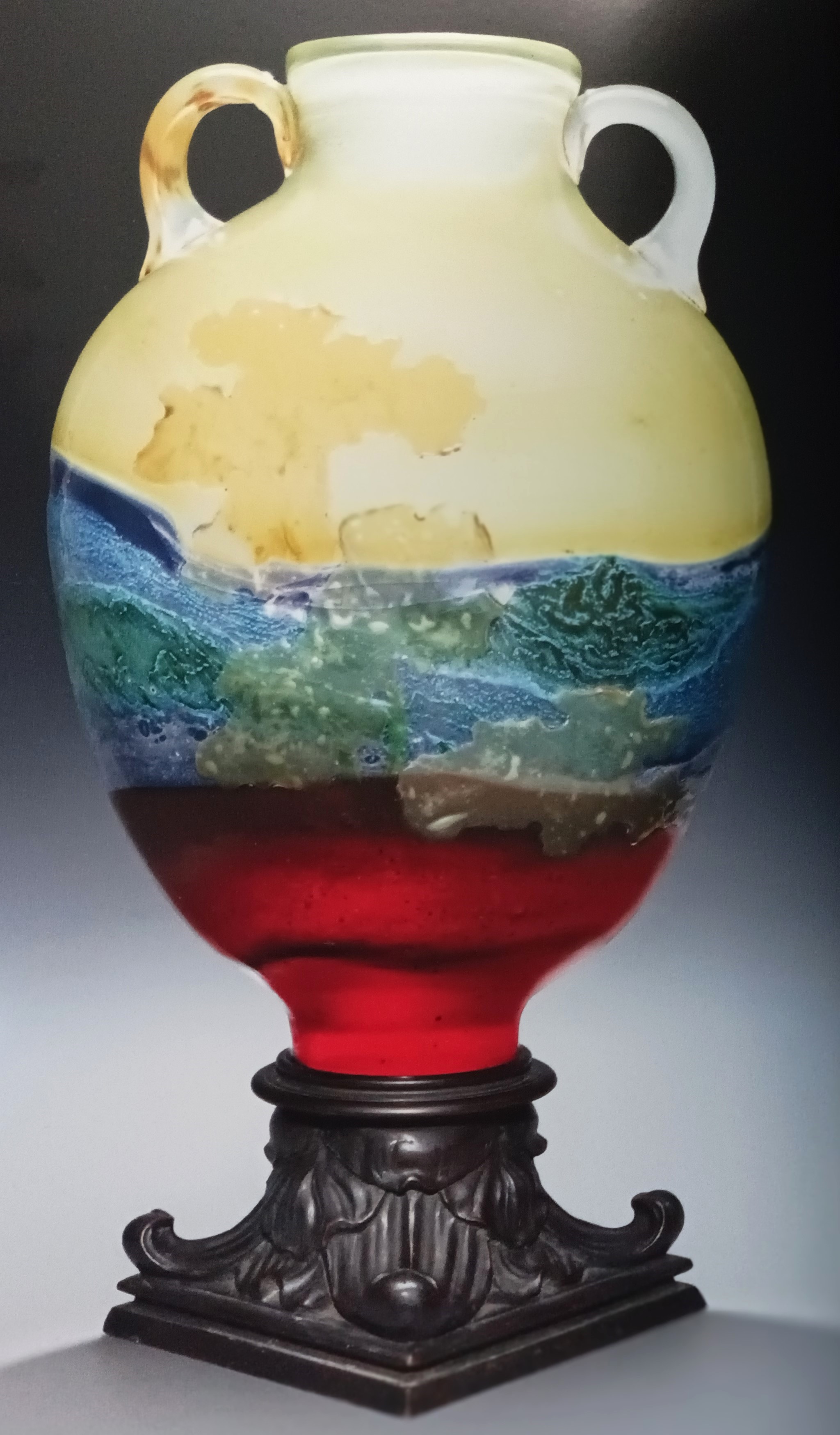
Émile Gallé (1846-1904) is a multi-talented artist, glassmaker, ceramist and cabinetmaker. He was one of the main actors in the revival of decorative arts at the end of the 19th and beginning of the 20th centuries as well as the one of the pioneers of Art Nouveau in France, playing a primordial role in the development of the School of Nancy. Creator of luxurious, extremely sophisticated, complex, refined and museum pieces, he presents himself at the same time as a “popularizer of art ” and was concerned with “cheap” production allowing him to finance the costly manufacture of exceptional pieces. When he created this “Rest in Solitude” vase, Art Nouveau was at its peak
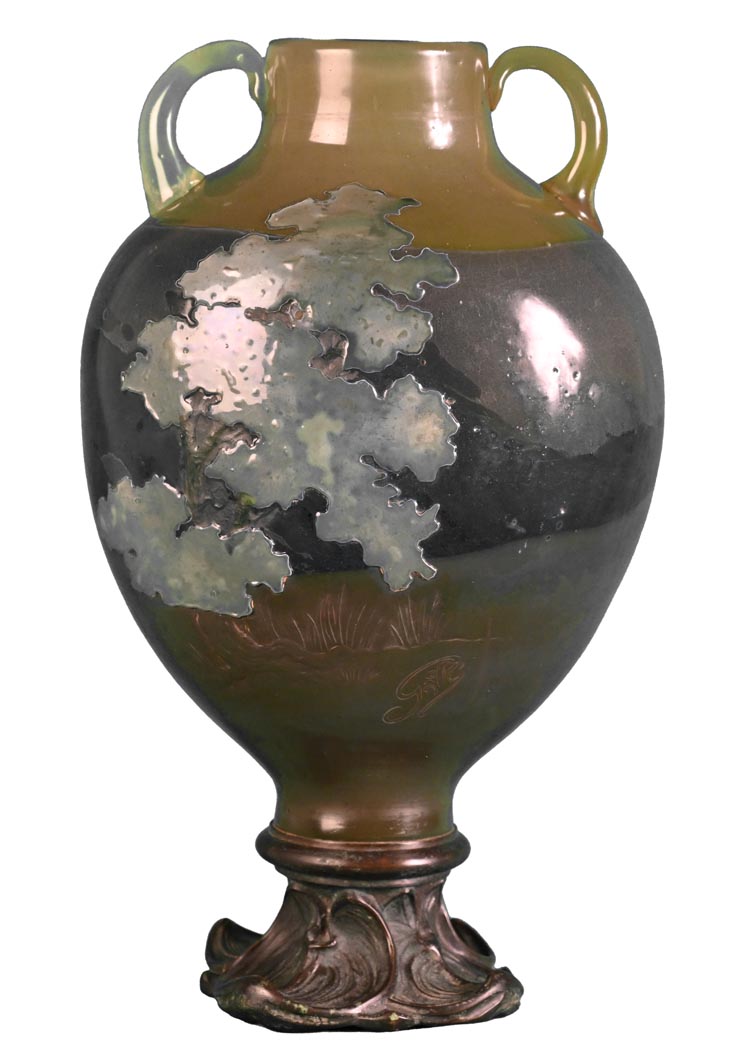
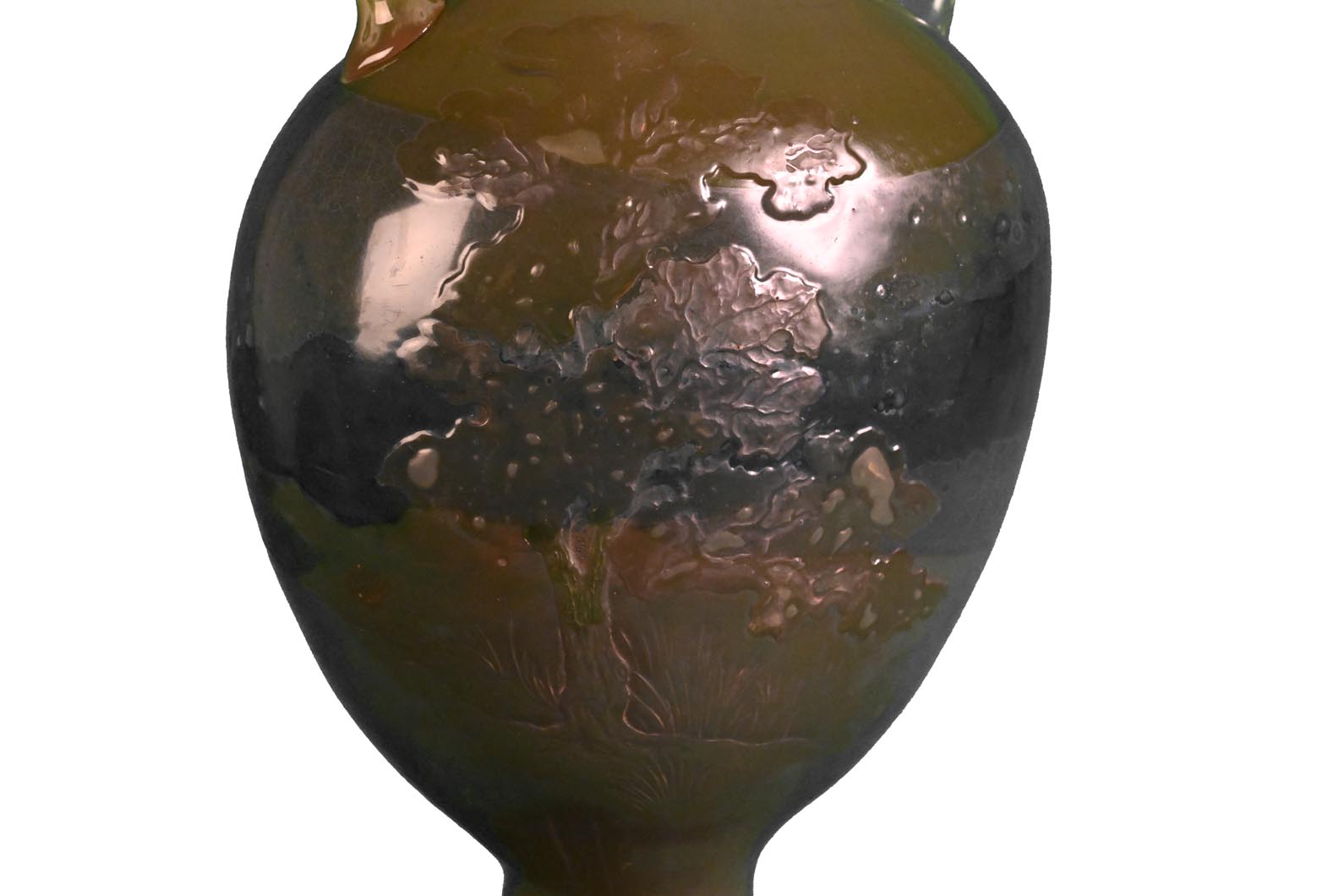
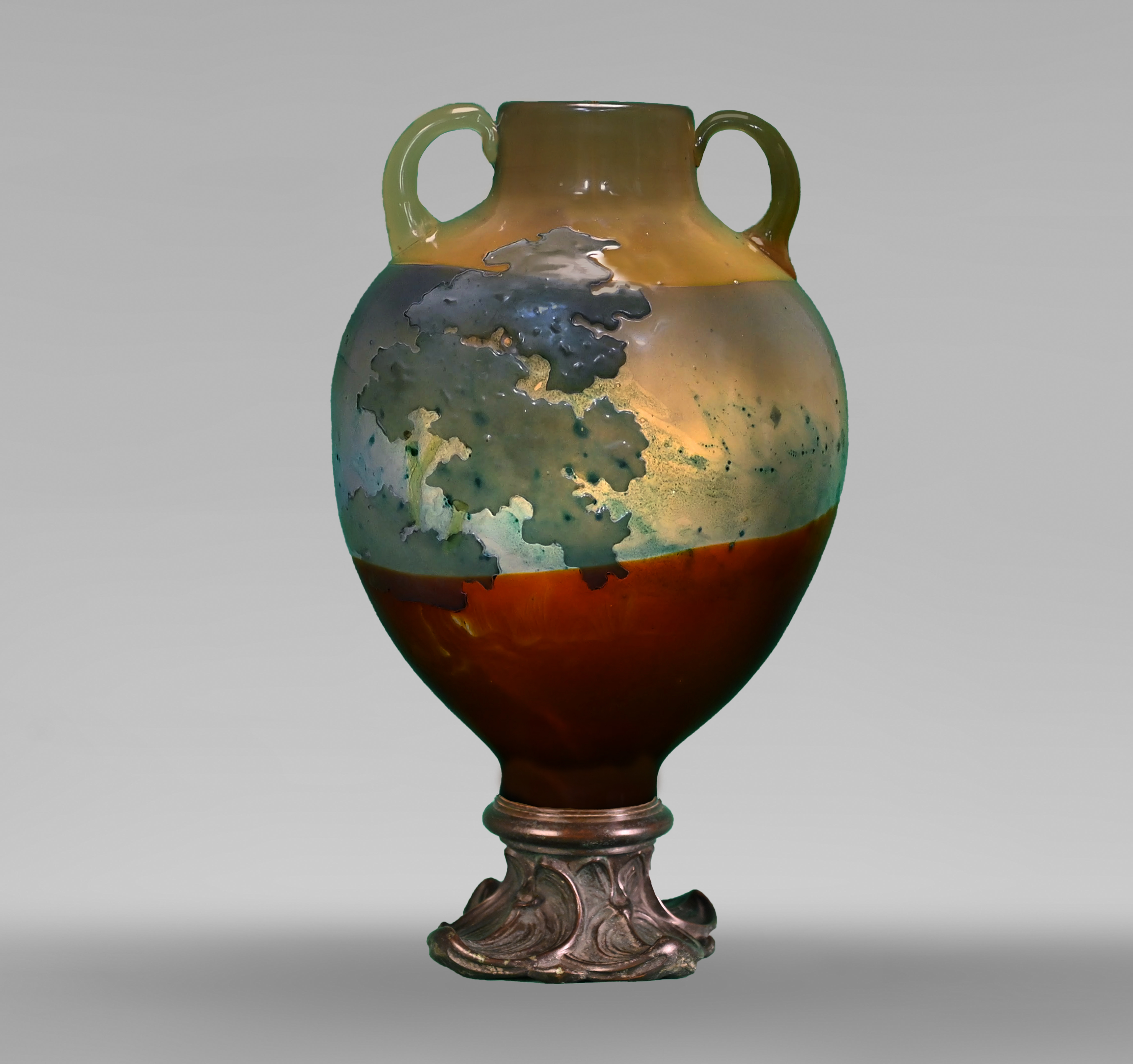
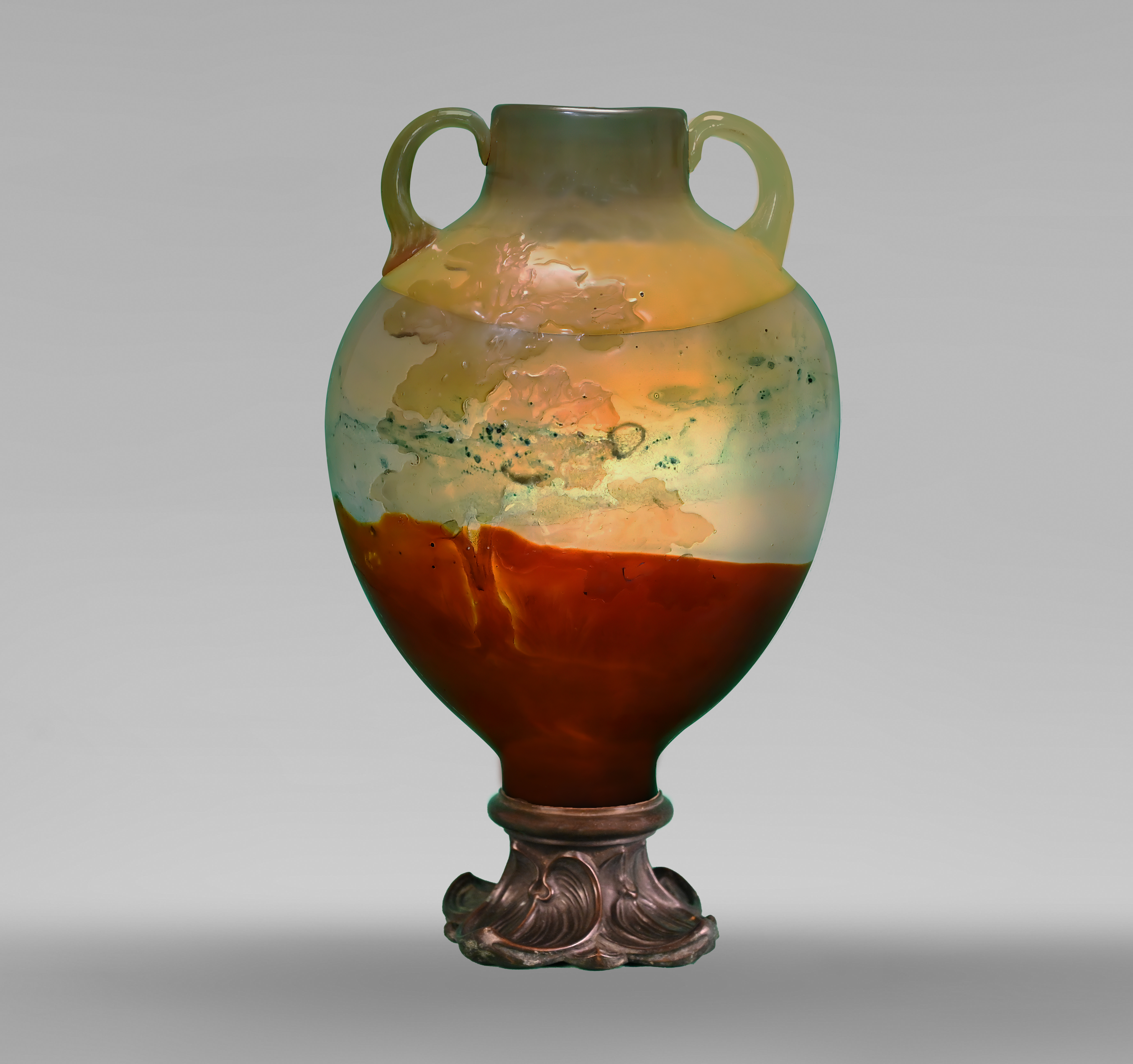
The vase rests on an original bronze foot decorated with stylized water lily leaves, elegantly curved at the ends. It takes the shape of an antique amphora. In fact, its body swells from the narrow foot before reducing at the neck. , flanked by two small handles The decor, which revolves around the theme of nature, which Gallé revered, is closely linked to the different techniques used to create it, pushed to such perfection that the work seems to transcend glass work It first presents a layering of colors that can evoke the four elements: its lower part is brown, to represent the earth; its central part is two distinct blues, one intense and the other lighter, superimposed or interspersed, for water and air; its upper part is light green becoming yellow under the effect of light to evoke fire, the sun
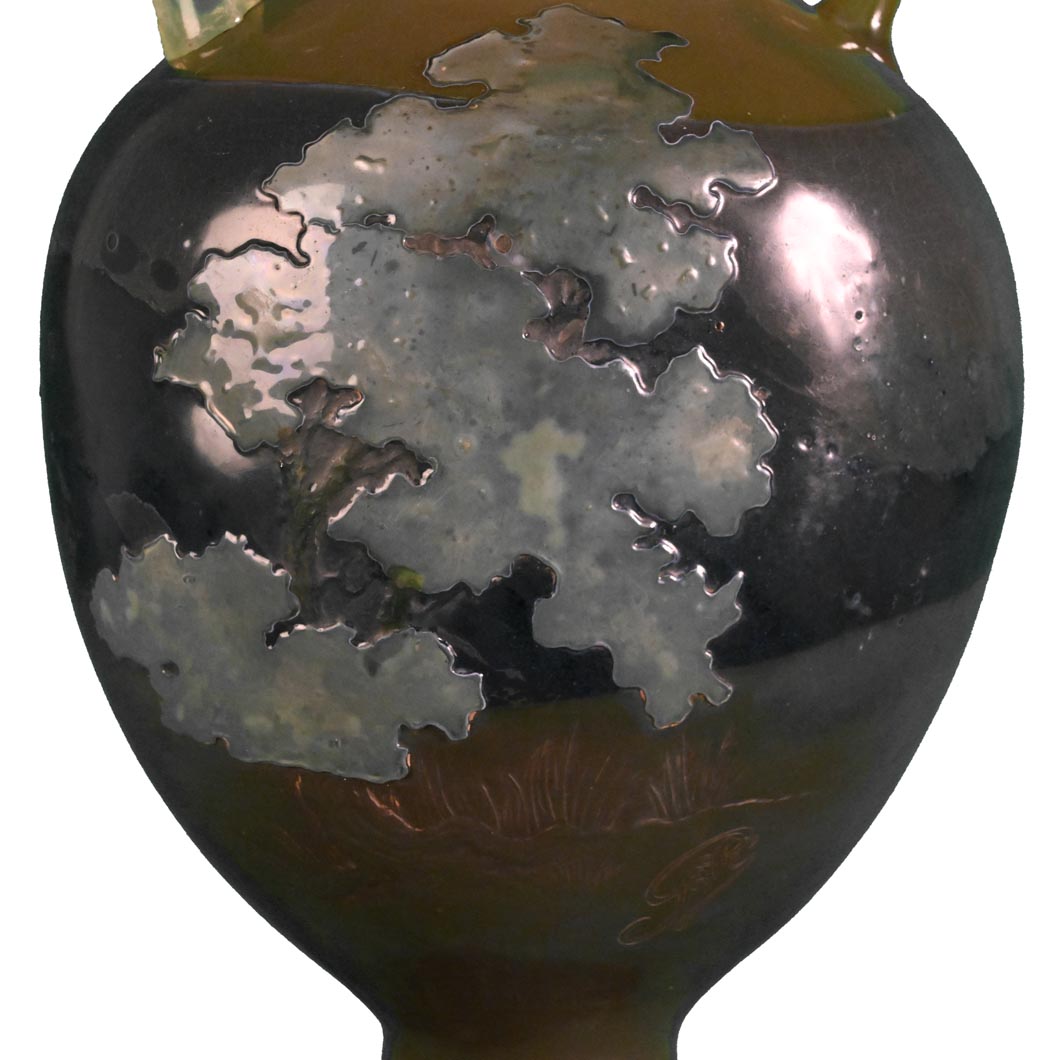
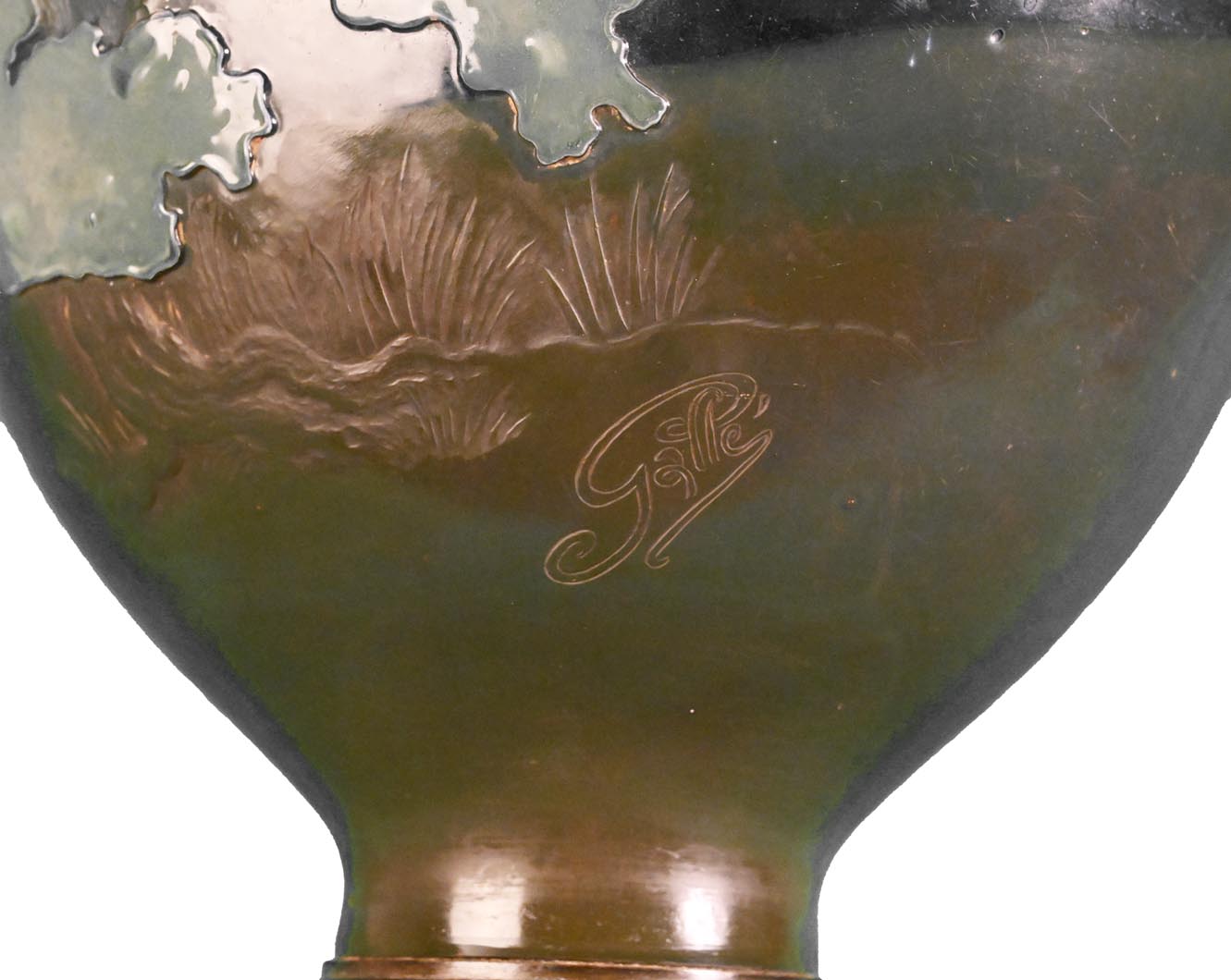
In addition to this layering of color levels, there is glass work on the surface. In fact, each side of the vase is decorated with a decoration of foliage which is a bold masterpiece of marquetry On the side bearing the signature of the artist, the milky foliage of the tree is included in the piece thanks to a glass marquetry technique patented by Gallé in 1898 (1); to do this, a worker had to add material when the vase was blown, these two layers of glass having to be maintained at the same temperature to avoid thermal shock at the time of superposition. The use of this technique explains the slight relief obtained, as well as the translucent character of the foliage or spring flowers, bluish by the presence of the sky in the background. To complete the decor, the base of the tree and the leaves of the plants surrounding it were taken from the wheel to accentuate the relief The tree decorating the other side of the vase also has a slight relief, but much less opacity; its branches and foliage are also chiseled with the wheel
To all of these complex glass working techniques is added a subtle variation invisible to the naked eye: when lit from within, the vase changes color. This chromatic variation can only be explained by the implementation of a particular technique similar to dichroic glass, which precisely changes color depending on the position of the light To obtain this effect, during manufacturing, a fine inclusion of metals such as gold and the silver is slipped into the glass matrix This is how this very contrasting set of colors appears. It is therefore part of the vogue for Japonism then prevalent, in particular with its trees represented on the surface and other stylized natural elements. It is also close to the Symbolist movement, by the melancholic nature that it presents and by the mystery of his inner illumination metamorphosing him While in painting, the impressionist movement was in full swing, the artist implemented an even more modern expression, almost abstract, by playing with the material. This work undoubtedly ranks among the most important of the 'artist
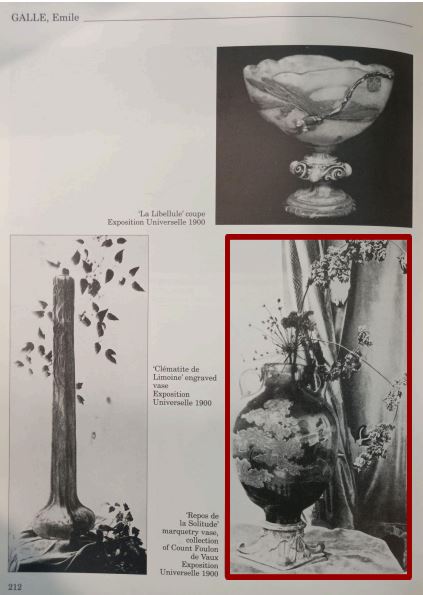
There are several other vases made on the same model. The last one to have been on the art market went on sale in Tokyo on March 25, 2006 at Est-Ouest Auctions (lot no. 85) This one had been exhibited in the window entitled “Repos de la solitude” at the Universal Exhibition of 1900, on the occasion of which it was noticed and praised by the public: critics notably recognized it as “an exquisite and, so to speak, new art” ( 3); the vase then bears the same name as the window, of which it is therefore the masterpiece and the archetype It belonged to the collection of Count Foulon de Vaulx (1873-1951), poet and novelist Like ours, it is also the illustration of Gallé's tireless research, both artistic and technical. Fascinating phenomenon, in the photo below, the vase is lit from behind, which makes its chromatic range identical to ours; no doubt, in the outside light, it looks more like our copy
Furthermore, one of the vases made on this model appears in an old photograph of the Association of Friends of the Museum of the School of Nancy published in Émile Gallé 100 years after his death (4) The foot of this one, like ours but unlike that of the 1900 exhibition, is not attached to a thin square base. However, if it is indeed identical to our vase in shape, it seems to present variations in the shape of the colored layers , which follow a less horizontal axis
Copies of this vase remain rare. Indeed, Gallé's most important and artistic pieces, aimed at a small and very wealthy clientele, were made in fewer than ten copies, notably due to the complexity of the techniques used.
The “Rest in Solitude” vase is therefore part of the production of “great genre” or “rich and half rich” pieces by Émile Gallé. The theme of nature dear to the artist is approached with poetry, as in a cup executed around 1900 bearing the same name and with a very similar decoration, a copy of which went on sale on November 22, 2016 at Sotheby's and another is exhibited at the Cognac museum. These pieces are emblematic of the production of the artist at that time, characterized by great freedom and great technical virtuosity, giving birth to some exceptional works, among which this piece ranks. By describing the world of nature in an abstract way, this work condenses its beauty, which the men perceive in a sensual and instinctive way, creating a magnificent universe
1 Art Nouveau & Art Deco, catalog for the Est-Ouest Auctions sale of March 25, 2006, p 53
2 Émile Gallé A contemporary look, catalog for the Sotheby's sale of November 22, 2016, 2016, p 67
3 Comte, Jules [dir], Art at the Universal Exhibition of 1900, 1900, p 362
4 Émile Gallé 100 years after his death, catalog of the exhibition at the Hida Takayama Museum of Art in Japan, 2005, p 113
Text: Galerie Marc Maison