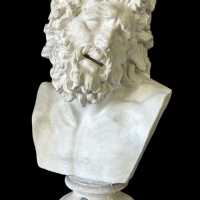
very important plaster bust representing Pierre Casimir Perier after Maggesi Dominique
In good condition, very decorative and very imposing
Dimensions: H 78 x W 69 x D 49 cm
Casimir (Pierre) Perier was born on December 8, 1777, in Le-Pont-de-Beauvoisin (Isère)
He is the fifth child of Claude Perier (1742-1801), a squire, wealthy banker and industrialist of Dauphiné origin, who contributed his own money to the preparation of the coup d'état of 18 Brumaire, and who was also one of the founders of the Bank of France in 1801.
With his brothers, he studied with the Oratorians of Lyon, then in Paris. Stendhal describes him thus:
"Casimir Périer was perhaps then the most handsome young man in Paris: he was dark, wild, his beautiful eyes showed madness."
Affected by conscription, he joined the Army of Italy in 1798. He became assistant to the engineering staff and distinguished himself at San Giuliano, near Mantua.
Having lost his father in 1801, Casimir Perier found himself at the head of a vast fortune. He left the army and, with the help of his brother Scipion, founded a major banking house in Paris. This house also dealt with maritime armaments, public and private debts, the timber trade, manufacturing, etc. It was notably one of the major shareholders of the Anzin mining company.
On October 13, 1805, he married at the Château de Vizille, property of the Perier family near Grenoble, a rich heiress, Marie Cécile Laurence (known as Pauline ) Loyer (1788-1861), daughter of Laurent Ponthus Loyer, a magistrate who died by guillotine in 1793, and of Joséphine Savoye des Grangettes, and granddaughter of the architect Toussaint-Noël Loyer.
They had two sons: Auguste Casimir-Perier (1811-1876), who was Minister of the Interior in the government of Adolphe Thiers (1871-1873), and Paul Casimir-Perier (1812-1897)
His business went well and he became a judge at the commercial court and then regent of the Bank of France. In 1817, he published two financial brochures against a loan of 300 million from the government abroad on very onerous terms. They were very well received. In the general elections of September 20 of the same year, he was elected deputy for the department of the Seine.
In politics, he supported the Charter and the Bourbons. His ideas did not go beyond the most moderate "constitutionalism". However, on several issues, he found himself in opposition to the ministers and the right of the Chamber. Re-elected deputy on May 9, 1822 in the 3rd arrondissement of Paris, he leaned more towards the left. After having obtained once again the renewal of his mandate on November 17, 1824, he led a very lively war against the Villèle ministry.
On November 17, 1827, he was re-elected deputy in Aube and rallied to the Martignac ministry. He was even seen appearing in the king's game at the Tuileries Palace. He was considered for the presidency of the Chamber and for the Ministry of Finance. He therefore maintained an almost complete silence during the sessions of 1828 and 1829. He did not return to the tribune until after the advent of the Polignac ministry (August 1829). His opposition revived his popularity and he naturally signed the address of the 221
Re-elected in Troyes on July 12, 1830, he did everything he could to stop the movement as the insurrection approached and in meetings of deputies and politicians. During the Three Glorious Days, he tried to show absolute neutrality. The victory of the insurrection brought him to power despite himself. He only definitively rallied to the Duke of Orleans when the fall of the elder branch seemed to him to be complete.. A few days later, on August 11, he was appointed minister without portfolio in the first ministry of the reign of Louis-Philippe I. He was re-elected deputy of Troyes on October 21.
After Lafitte's resignation, Casimir Perier was called upon, on March 13, 1831, to form a ministry in which he became President of the Council and Minister of the Interior. His policy aimed, internally, to restore order by energetic measures and, if necessary, by force. Externally, it aimed to guarantee peace with foreign powers.
Casimir Perier meditated for a long time on what the presidency of the Council should be. He theorized a quasi-parliamentary regime, in which the cabinet is strong and "the king reigns but does not govern", according to the famous maxim of Adolphe Thiers. To impose himself on the chamber, he made an investiture speech in which he developed his government program. This is summarized in a famous formula which defines the ideal of the "happy medium":
“Within, order without sacrifice for liberty; without, peace without cost to honor.”
Tall, with a burning gaze, energetic gestures, cold, loving to exercise command, Casimir Perier has a charisma and a natural authority that all his contemporaries underline. He is a hard worker, concerned about his status and the role of France in Europe.
The continual struggles of the ministry and the overactivity and excitement in which he constantly lived undermined his fragile health. Anticipating the cholera pandemic which hit France in 1832, he gave instructions for the strengthening of health controls.
On April 6, 1832, the king asked him to accompany the Duke of Orleans to the Hôtel-Dieu, to visit cholera patients. He died a few days later, on March 13, in Paris.
Important Bust of Pierre Casimir Perier Sculpted by Dominique Maggesi - Empire Plaster

Send to a friend


 Laurent Brion : +33(0)6 09 90 34 72
Diego Irribaria : +33(0)6 33 04 44 83
Contact Antiquités Laurent Brion
Antiquités Laurent Brion
Laurent Brion
Marché Serpette
Allée 4 Stand 7
Allée 4 Stand 7
Laurent Brion : +33(0)6 09 90 34 72 Diego Irribaria : +33(0)6 33 04 44 83 brionlaurent@live.fr