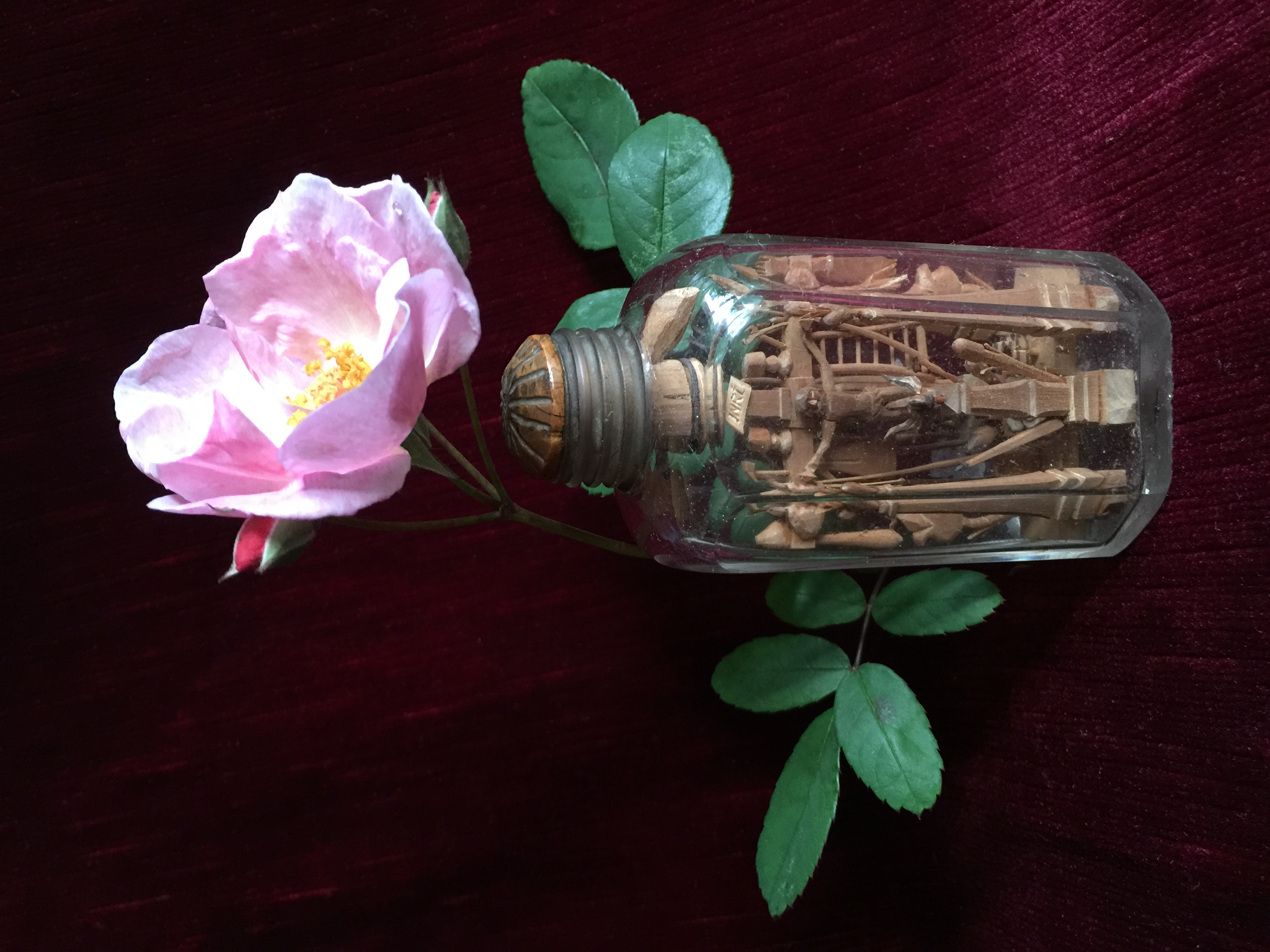
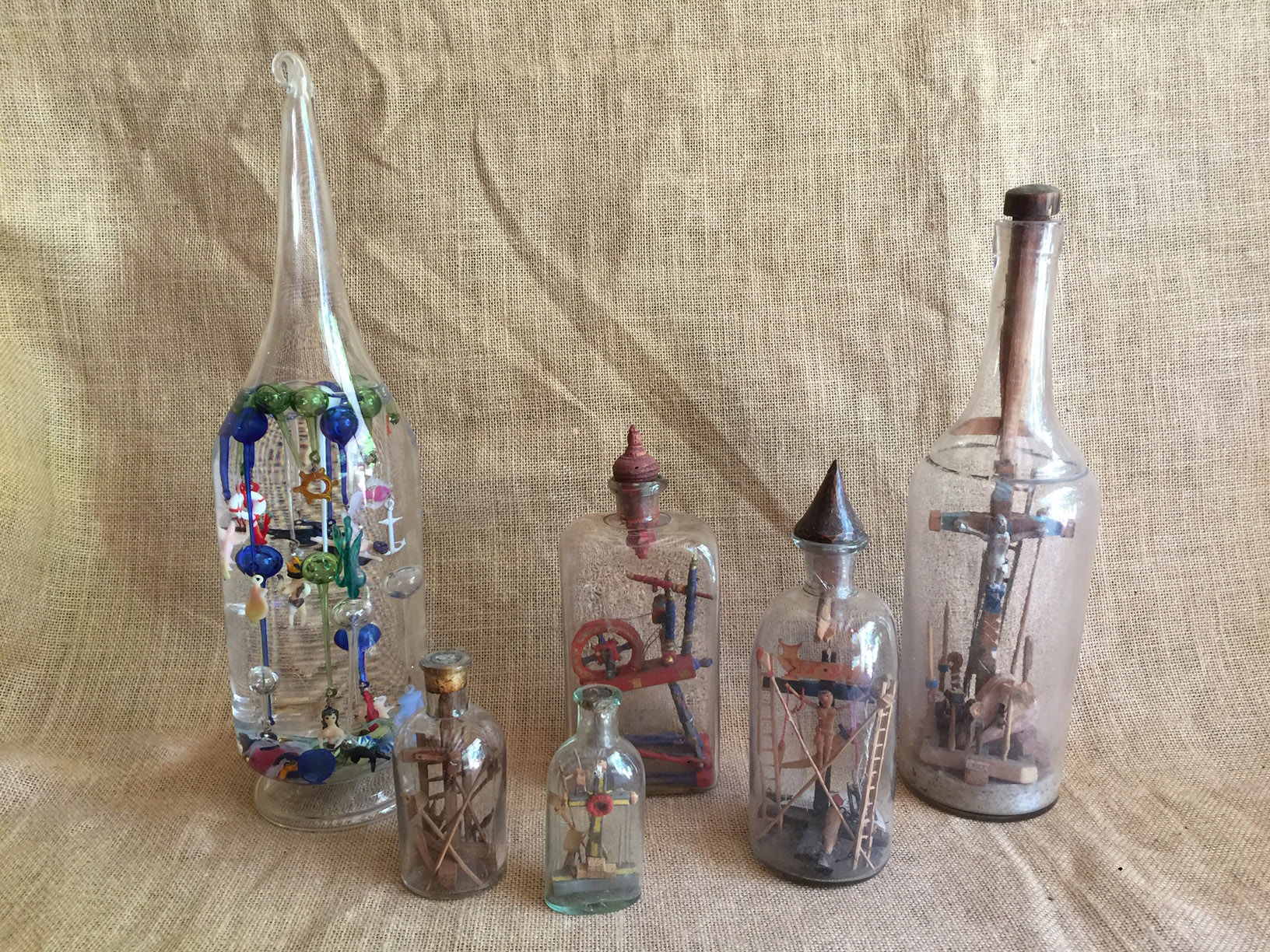
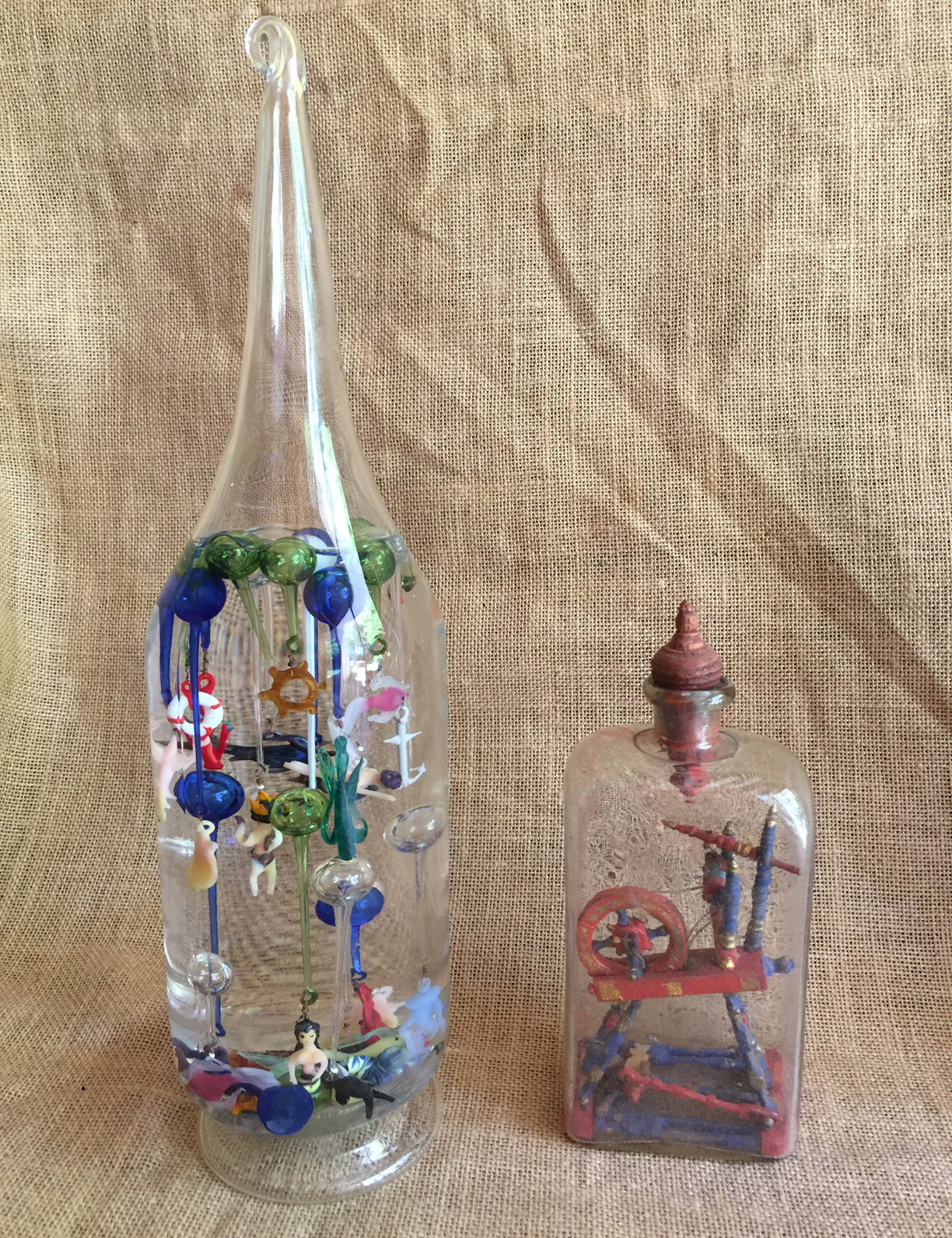
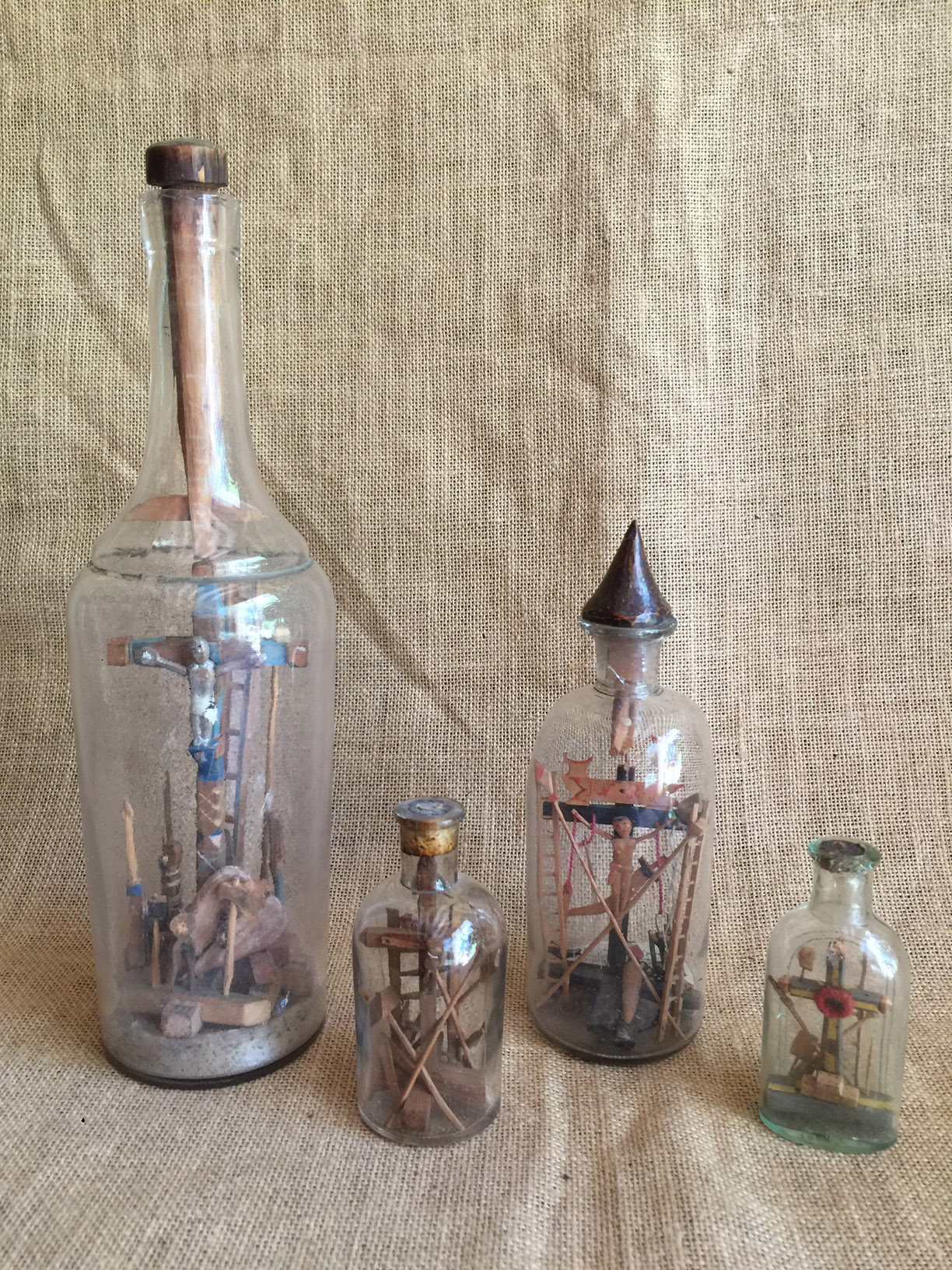
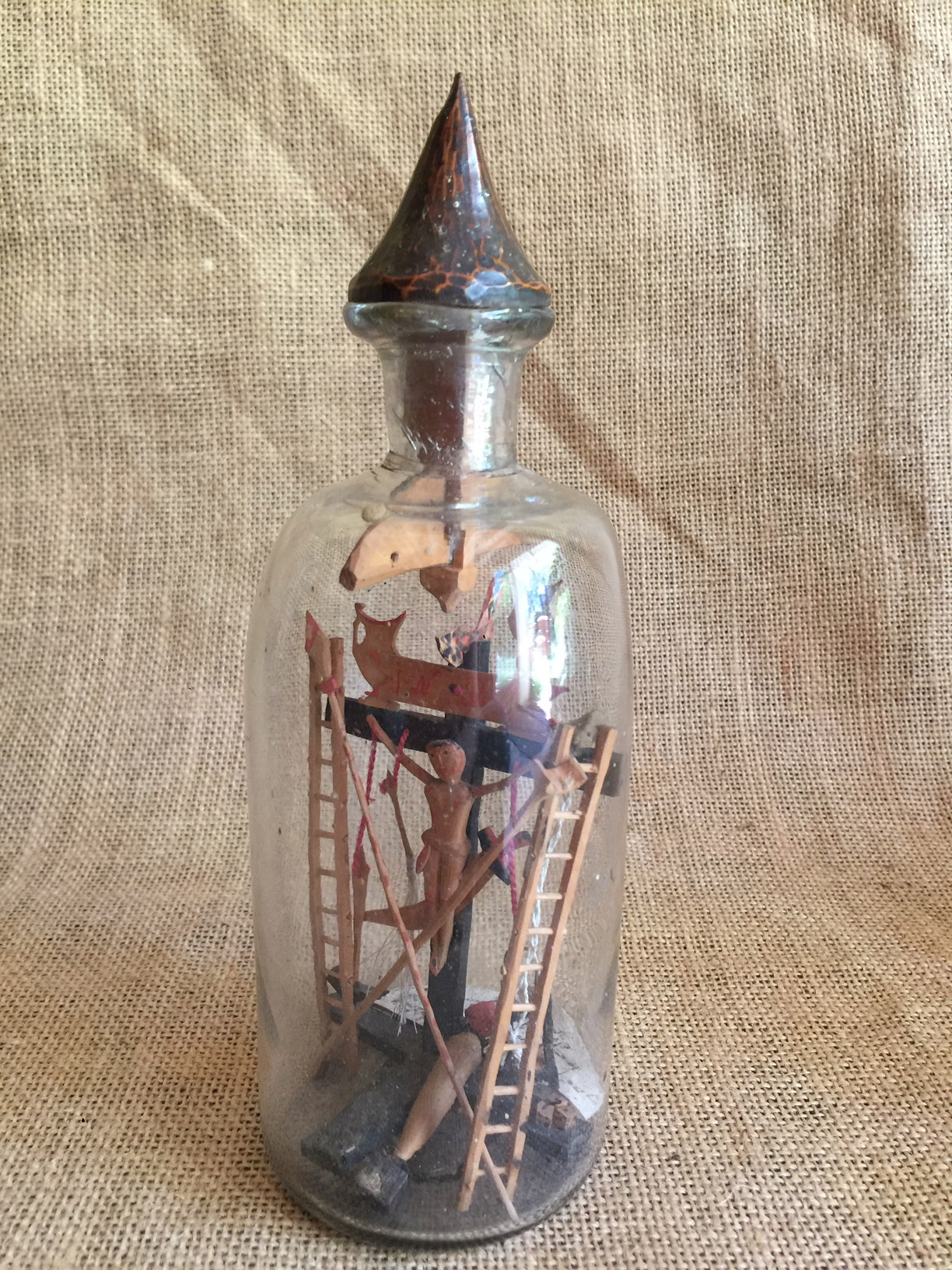
Inspired by the romantic theme of this week, Samuel Collin and Catherine Assenedellec (Les Couloirs du temps) tell us the story of the bottles of passion and the Exs Votos, real objects of life ...
“The bottles of the Passion, small calvaries in bottles, and often ex-votos, are made with all the naive charm of boatmen, sailors, who here and there recovered“ lost ”elements. Sustainable development ahead of time and development of works of the heart, resulting from the authenticity of a non-academic know-how and nevertheless of an extreme ingenuity. One can admire in front of the roughness of these men, their heavy hands become so light of skill to fit many tiny, finely carved objects into very small bottles.
Indeed, it is difficult to imagine the coarse hands of these men, full of calluses, one by one shaping delicate small objects, miniature chalice and crosses, very small multiple tools, body of Christ, details of the Cross and the Instruments of the Passion, with an incredible dexterity necessary to be able to assemble them in the bottle. Remember that these bottles were not very big, less than 10cm for some! Already a small miracle ... but above all a call to prayer of thanks for the return journey in the hearts of these boatmen ...
These charming scenes are sometimes painted, probably with the remains of paints used for the boats. Most are made with humble little pieces of wood, shavings and the remains of carpenters' cuttings, sometimes with small pieces of metal , small pieces of cardboard or paper like cut-out pious images. Christ on the Cross is often made in a very rudimentary way, sometimes even with a small piece of carved bone. The talent of the "simple" (or Saints) will say some ...
We can thus discover with delight in the bottle, a mini-paper banner, with a name, or only a few initials, a musician cherub hanging from a thread, a holy Bishop, a holy martyr or a Saint… perfectly unknown! And a whole bunch of small objects assembled around Christ… the Instruments of the Passion !! Also intriguing the key across the cork that closes them. But alas, all this is often partially loose at the bottom of the bottle. In fact, unfortunately, these bottles have only very rarely been kept.
A little bit of history...
For the traveler, in the past, danger was everywhere, on the roads which were unsafe, and even more on the waterways which were used for the transport of people and goods. Crossroads and bridges were particularly feared. elsewhere than they were evil places where witches and evil spirits gathered. But they were particularly feared because of the slowing down of travelers to this place: not only could one take the wrong direction, but they were a privileged time and place to tend a trap And like crossroads on land, bridges were a good place for ambushes, and also because the currents could throw the boat against its stacks.
From the earliest times, rivers and streams have been of primary importance in the life of men, used for the transport of goods and people, and this because transport by land was long and difficult, very uncomfortable and dangerous because of the poor state of the roads, the relief ... and especially the bandits who robbed travelers. Travelers, sick or not, drank the water from the source, and sometimes bathed in it In Celtic mythology, the Gallic sailors of the Seine already offered Sequana, the naiad of the sources of the Seine, ex-votos intended for to protect them.
So we still find today many ex-votos in the chapels that line our coasts and our rivers, our small and large rivers, and, with just as many miraculous springs dedicated to the Virgin or to a Saint healer, to a Saint who is sometimes only known to the people of the village and the surrounding area ...
The sailors, the boatmen built Crosses to be protected, as they did in all the places of dangerous navigation, like what was done on land, but giving these Crosses distinctive signs marking their very special assignment. To the Boat Industry: the Cross is often represented with an anchor in its center (the anchor, in addition to its own marine symbolism, is a primitive Christian symbol, from the 1st century, like the symbol of the fish, Ichtus in Greek, an acronym, an acrostic, a play on words for "Jesus Christ God Son Savior").
The Seine, the Rhône and the Loire, waterways of primary importance, have always been very frequented by boatmen; but, tumultuous rivers, they were particularly dangerous! The boatmen of the Rhône were the first to erect Crosses on its route, they also placed them at the stern of their boat with Christ on the Cross surrounded by a greater or lesser number of instruments of the Passion But why the boatmen have chosen the instruments of the Passion? And why did the sailors specifically carry out calvaries in bottles with the instruments of the Passion? This is where the history of Popular Art joins the history of France.
In the 13th century, in 1238, King Saint Louis bought Christ's crown of thorns from the Emperor of Constantinople, and he had to bring it back to France (where he would have the Sainte Chapelle built to welcome it). trip from Constantinople to Venice, and from Venice to Paris. This last trip was made by land to Sens. Arrival in this city, in August 1239, the precious relic was entrusted to the boatmen who transported it by boat on the Yonne and on the Seine, to Vincennes and Paris.
All the boatmen therefore decorated their boats with the usual Cross, of course, but also with a crown of thorns in the image of the holy relic entrusted to their care to mark the great honor that had been granted to them, and they added the instruments of the Passion to them. They themselves sculpted these wooden Crosses which, for those intended for the boat itself, were vividly colored. Others were made in wrought iron and placed in Oratories or Chapels who were consecrated to Saints protectors of sailors and mariners, and established all along the river, as on the towpaths. But the boatmen also wanted closer protection, also closer to their "relatives", their homes and their families.
Also one found in the houses of the boatmen, then in the cabins of their boats (barges, barges), Crosses, made in the same way, but smaller These small Crosses were first made in a kind of small niche, an oratory, a carved wooden shelter, which allowed the multiplication of symbols, multiplication which can also explain certain transformations according to the prayer intention of the one who made it. Only the nobles and the rich could acquire glass objects made by renowned master glassmakers. Glass bottles were therefore rare and very expensive; and above all the glass was not very translucent and studded with air bubbles, with the exception of exceptional bottles intended for apothecaries, but they were even rarer and even more expensive.
So, with the industry and the diffusion of glass in the 19th century, a greater number can acquire or recover it. But despite everything, and for a very long time, it was rare to have it, and when people of modest origin had them, they were also with the awareness of holding a "beautiful" container, they took care of them, recovered them, kept them ... and, naturally, gave them a second use, a second life: they made them an object of folk art, decoration and devotion including for sailors a boat, and for boatmen, a Cross surrounded by the Instruments of the Passion.
To thank God for having heard their prayers, and also to give them to their bride, to please her, or to keep them as a souvenir and object of devotion entrusted to their loved ones. island of Tatihou (Manche, Cotentin), an island which for a long time served as an island for quarantine, then for convalescence (airlift) for war-wounded from the 14-18 war. Sale in religious stores and places of pilgrimage, such as those with chromos, cut and glued paper images.
And all this… in a small bottle, holding in one hand !! So ... if you find one of these little glass bottles, all dusty, a little kitsch, with a little opaque glass, sometimes with a few loose elements at the bottom ... it is also to find a little piece of the heart of a boatman who sleeps… like a little genius in this bottle, a little genius of Popular Art !