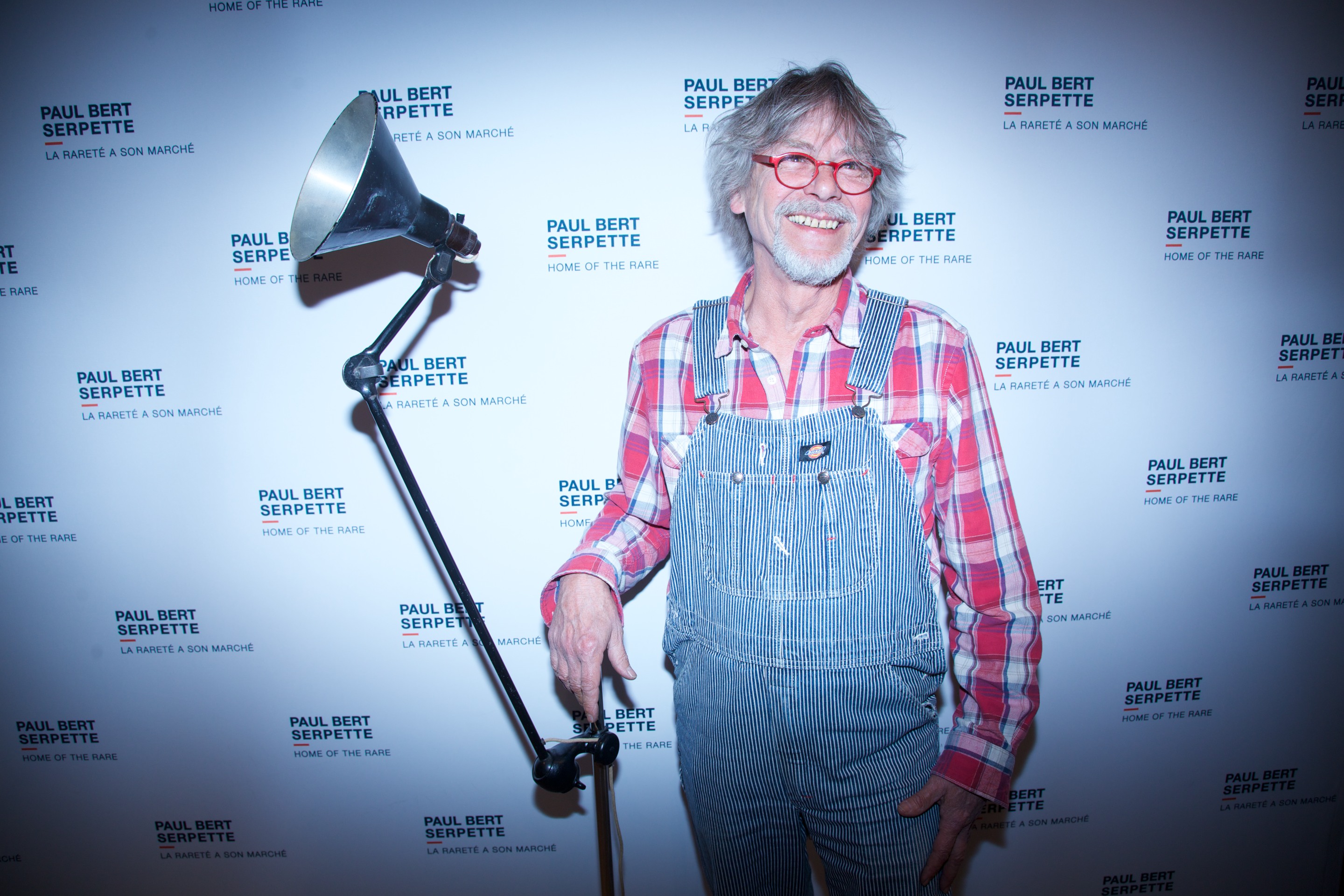
Dungarees and red glasses like Coluche, Gilles Oudin is not a joke. His job, he knows. He has practiced it since his majority. Its furniture too. He is even one of the world's specialists. Industrial or rather professional, it is that of workshops, workshops and construction sites. A whole modern world born at the beginning of the last century of which Gilles knows the history by heart.
PIONEER OF THE INDUSTRIAL FURNITURE Gilles is still studying in an agricultural school and is engaged in the trade of antiquities. Taking advantage of his country life to hunt during the week, he sells his finds in Paris on weekends. At the creation of Serpette in 1977, he was one of the first to open a stand there. Stand he doubled from a shop in Paris in the 2nd first and then in the 9th after. Late 80 early 90, weary of the classical furniture, it turns to the factories and companies whose equipment is demoted. It then pushes the doors of an unknown and still denigrated world that only needs to be explored. From factories to hospitals Gilles will tell you, the great upheaval takes place after the First World War. Businesses are (re) rising. The chimneys are activated. Hardware catalogs explode. The work is modernized and the place of the worker in the workshop becomes an issue. The designers look at the issue of the body at work and innovate by adapting the furniture to each trade. Innovations that will soon pollinate the family sphere and penetrate into the interiors. Thus the folding chair, known to all today, which, invented in 1920 by two American brothers settled in France under the name Bienaise was originally designed for workshops.
SAVING A HERITAGE Molds with buttons, nail racks, operating room lighting, hand castings, movie spots, everything is found at Gilles Oudin. Of everything and especially of big names of the industrial age. René Herbst, co-founder of UAM, whose offices remain precision models. Singer who did not just make sewing machines but equip seamstresses from chair to reel. Bernard-Albin Gras and adjustable desk lamps of which Gilles Oudin can trace all the evolution. Strafor, the Rolls Royce of office automation since the 1930s or Theodore Scherf, whose shelves populated the shops of mouth. If all these signatures are now recognized, they owe it mainly to Gilles. Still a man of the shade who defended these creations with passion. A man of the shade whose name you will find in the acknowledgment of the books dedicated to this professional furniture of which our interiors were freely inspired.
Gilles Oudin, stand 405, allée 7, Paul Bert
See also:
Cyril Grizot, in the shadow of Lebovici