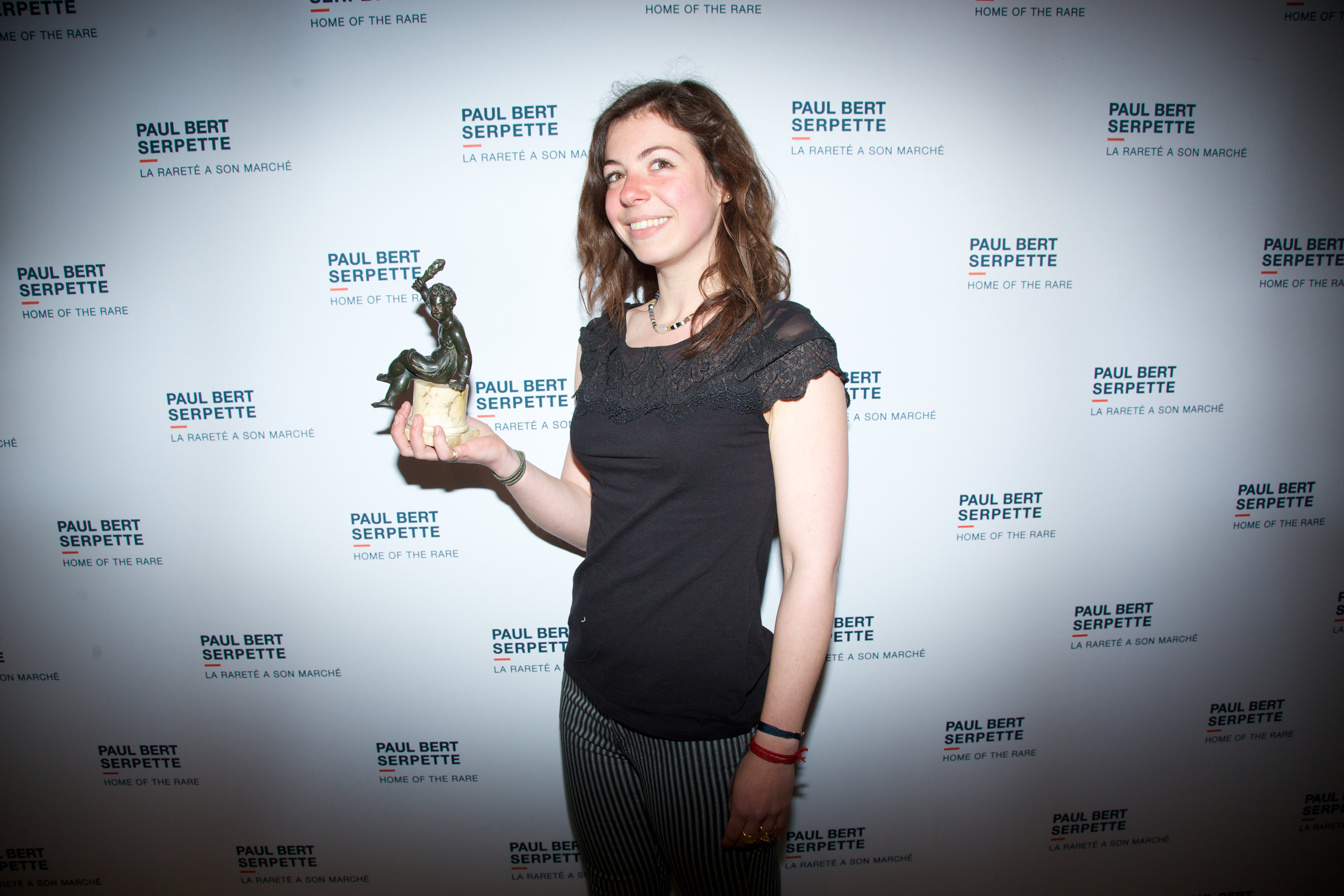
The discreet Elise Jullien conceals her game well. In her small stand with scarlet walls, she arranges in scholarly presentations her finds of the week. Scattered in the shop, books, catalogs and monographs to support and clarify the stories of the many treasures of the Upper period that surround it. Because Elise is one of those researchers who have made the bet to find in real life what they found in books. A bet that succeeds.
A LITERARY KNOWLEDGE Six years ago. Six years that Elise discovered Paul Bert Serpette and no longer left this market. Initially a trainee, she quickly opened her stand, taken from the game of antiquities. Trained at the IESA, this student of medieval literature tried her hand at modern design before returning to her first love: the Haute Epoque. His ambition was to acquire, promote and defend those museum pieces that populate the novels of Chrétien de Troyes and Rabelais. She has passion, knowledge of texts and especially the singularity of this rare period in Flea. ANOTHER MEDIUM-AGE. It must be said that very few objects have reached us. At the time, production of parts was limited. The Church was its main sponsor. Unique, hand-made, of a rare and delicate quality, these objects do not belong to the domain of decoration but to that of reverie and of History. Their finesse and their subtleties fascinate Elise. Let her explain to you the evolution of the style of the perizonium, the wise name of the stuff that covers the hips of Christ: the more one advances in time, the more narrow it is! Similarly, before the Counter-Reformation, the Ecstatic Virgin very often shows her breasts. Painters taking advantage of the pious subject to delight the eyes of their sponsors. What is hidden behind the image is the stake for Elise.
AN INSPIRING RENAISSANCE Unlike the Middle Ages, the Renaissance is a formidable period of freedom and artistic production. Turning into the history of art, she rediscovered the Ancient and established new canons. Models that are interpreted each time differently by the artists, each appropriating the work of the other and blurring the tracks. Then begins the favorite game of Elise: to go up the source of a work, to find its author, to unravel its origins. For what better gift than to hold in his fingers a glass of the fifteenth, miraculous of the ages? Or this portrait of a woman from northern Italy, of which Elise keeps a living memory. A portrait on terracotta, material whose epidermic qualities allow a rendering of a striking veracity. What could be more fragile than glass or terracotta? And yet, they are there. Still and always. And they inspire and move us. Still and always. Touching a distant past. It was for this dream that Elise started. Like a Madame Bovary of the Renaissance, she wanted to go back to books. It is her quest for the Grail.