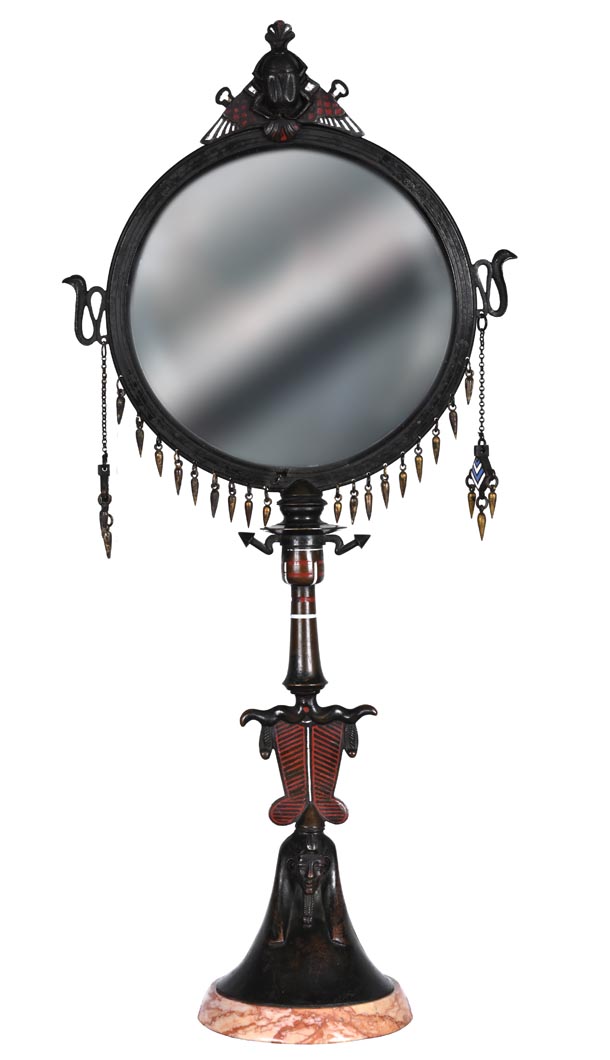
Giuseppe PARVIS (attributed to), Egyptian mirror, circa 1900
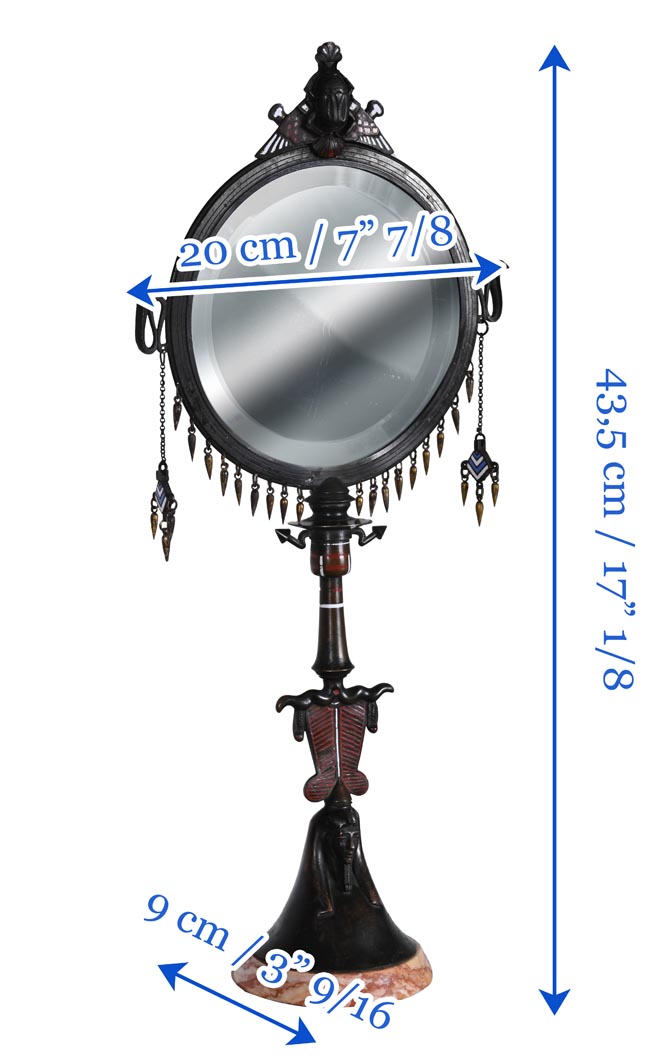
Dimensions
Width 20cm
Height 44cm
Depth: 9cm
Born in 1831, Parvis studied at the Accademia Albertina in Turin before succumbing to the fascination of Egypt. Settled in Cairo in 1859, he developed an exceptional know-how in Egyptian furniture. His talent led him to international recognition, notably thanks to the Universal and International Exhibitions of Paris (1867), Philadelphia (1876), Milan (1881) and Turin (1884), where he distinguished himself with prestigious prizes. Appreciated at the court of the Viceroy of Egypt, he participated in the fitting out of several palaces before returning to Italy in 1900. At the dawn of the 20th century, Parvis exported a large part of his production and left a deep mark on the decorative arts market.
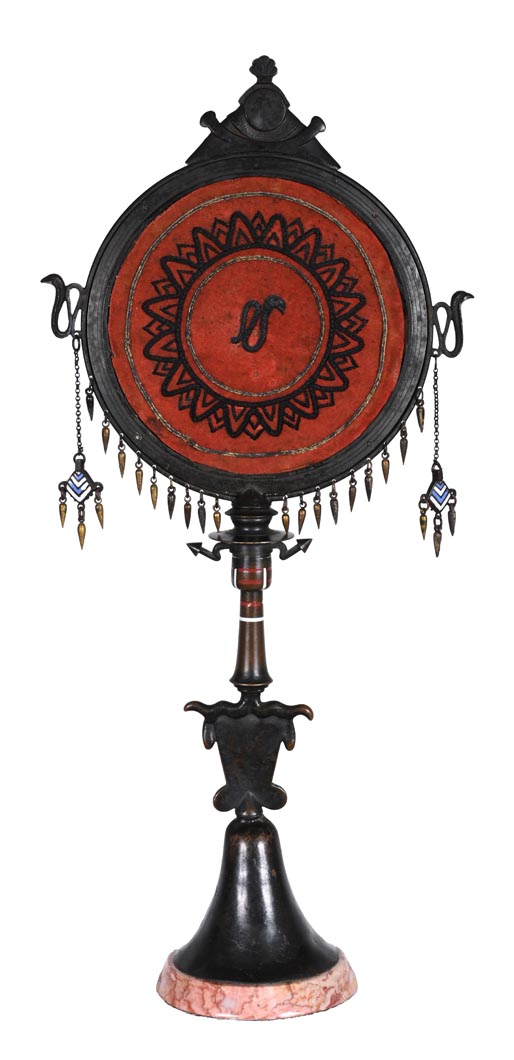
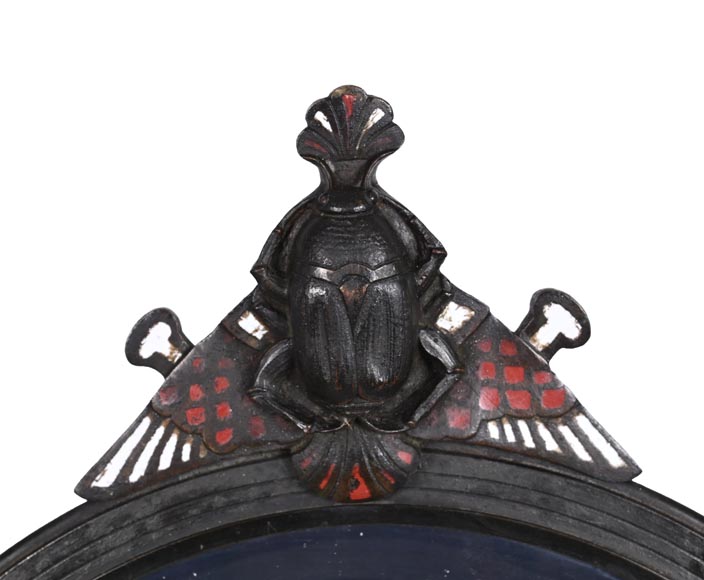
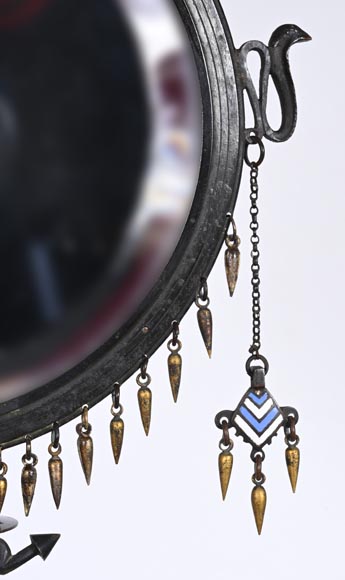
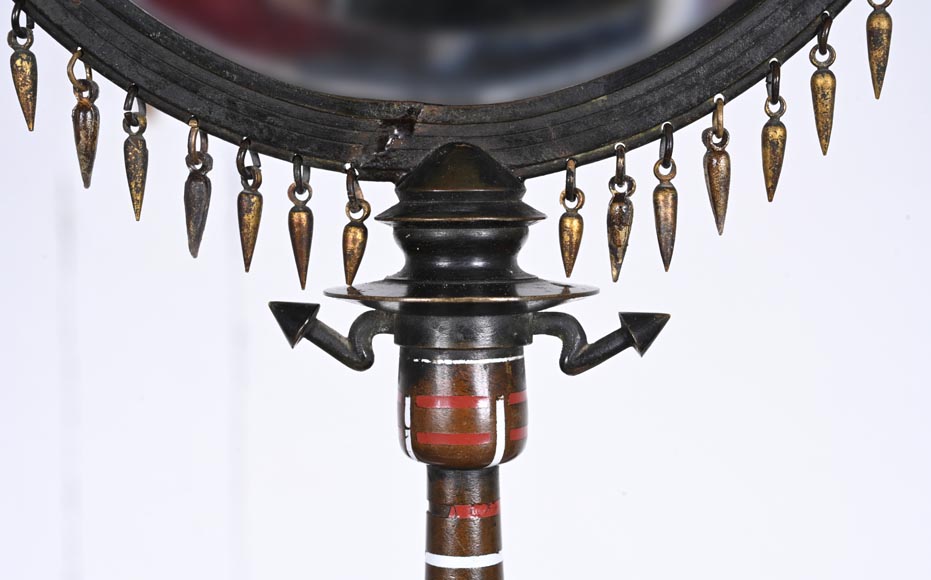
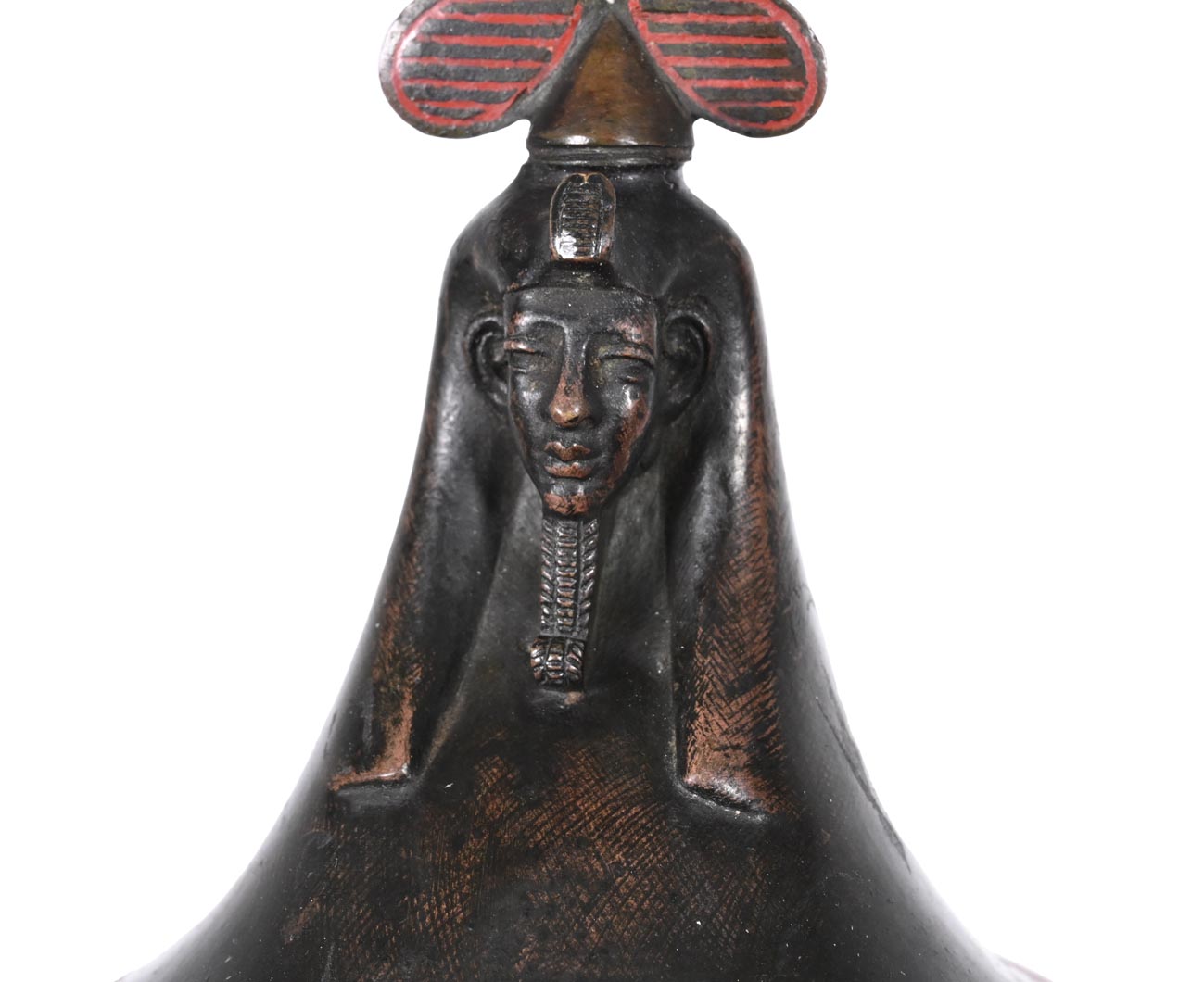
The base of the mirror takes the form of an inverted stylized lotus corolla, in which an Egyptian face adorned with a false beard is outlined. It rests on a pink marble base and rises up to an inverted Egyptian divinity headdress, reminiscent of those adorning the four statues at the back of the sanctuary of Gerf Hussein. Its circular mirror is framed by multiple pointed pendants, while two lateral serpents evoke the uraeus, the royal emblem of the pharaohs. Two pendants decorated with blue and white chevrons complete this symbolic ensemble. The object is topped with a scarab with falcon wings, a reference to the god Khepri. On the back, an embroidered fabric displays geometric patterns inspired by ancient Egypt, as well as the uraeus.
The fruit of an Italian's passion for Egyptian civilization, this mirror is fully in line with the tradition of Egyptomania, which spanned the centuries to permeate European decorative arts until the 20th century.
This mirror thus embodies the fascinating dialogue between East and West, where the heritage of ancient Egypt is reborn under the gaze of a European creator. A refined testimony to Egyptomania, it illustrates the lasting influence of this civilization on the decorative arts.