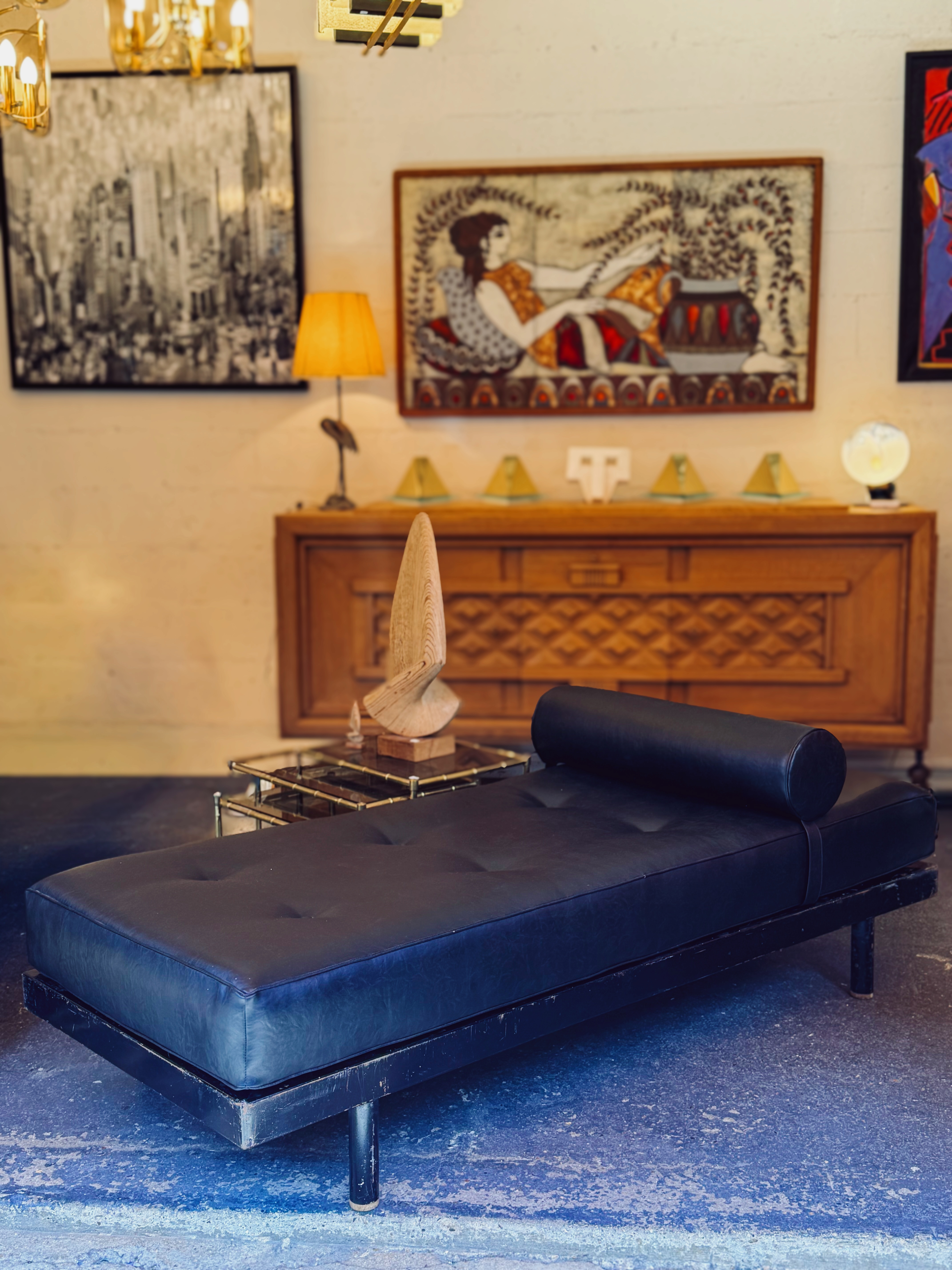
When furniture becomes manifest
There are objects that tell the story of an era better than a history book. The SCAL n°450 bed by Jean Prouvé is one of them.
Designed in 1952, this model became in 1953 the only bed produced by the Jean Prouvé workshops. A well-deserved monopoly, for a piece that embodies the entire philosophy of its creator: formal simplicity, industrial materials, structural efficiency.
A name steeped in history
The name "SCAL" is not insignificant. The Société Centrale des Alligateurs Légers (SCAL) was founded in 1939 in the context of rearmament, to build a light alloy factory in Issoire. It was on this construction site that Prouvé began a crucial collaboration with the architect Pierre Jeanneret, focusing on the issue of prefabricated housing. The bed thus bears the marks of this foundational endeavor: steel, tubular construction, oak legs—all stemming directly from the logic of industrial construction applied to everyday life.
The bed of the University City
The model was used in 1955 to furnish the rooms of the Cité Universitaire in Antony, near Paris, which is why it is also called the "Antony" bed. Some versions have a swiveling shelf designed by Charlotte Perriand, a perfect illustration of how Prouvé liked to surround himself: with minds as rigorous as his own.
Geometry as a program
With its black lacquered metal frame, tubular legs resting on oak glides, and clean lines, the SCAL No. 450 doesn't try to seduce. It convinces. The diameter of the tubular legs, protected by thick wooden caps, was increased to 50 mm in 1953, and the model was available in three widths: 80, 90, and 140 cm. This rationalization is typical of Prouvé, who conceived of furniture as one would conceive of a structure.
The SCAL bed is design in its purest form: no ornament, no compromise, just form following function, and lasting.
Sources
jeanprouve.com (catalogue raisonné), Galerie Patrick Seguin, Galerie Downtown François Laffanour, Los Angeles Modern Auctions (July 2024), Tajan Paris (November 2019).