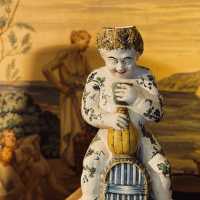
Rouen, faïence de
Earthenware from Rouen
The first traccks of the Rouen factory go back to the 16th century with the workshop of Masséot Abaquesne, who died in 1564. The factory regained its luster in 1644, when Nicolas Poirel de Grandval, bailiff to Queen Anne of Austria , obtained a privilege authorizing him to make earthenware for 50 years in Rouen, sheltered from all competition.
Rouen rightly occupies the first rank in the history of the ceramic industry in France, not only by the importance and the number of its factories, but also and above all, by the artistic perfection of its products. The superiority of Rouen earthenware come from their irreproachable manufacturing, the beauty of their enamels, the purity and intensity of their colors, especially blue, is the great decorative feeling that we notice. in all pieces, even the most ordinary. It is this architectural decoration which puts each motif in its proper place and which harmoniously emphasizes not only the whole of the form, but also the smallest molding or the least important relief.
Rouen decoration earthenware has varied greatly; in the first products, which remain very rare, a nivernaise influence is clearly visible, both in terms of form and decoration. Just like Nevers, Rouen began its production with dishes and plates with wide edges and a narrow basin. Towards the end of the 17th century, the decoration known as lambrequins appeared on earthenware. This decor was first executed only in blue shades. It generally consisted of two alternate patterns, linked together and repeated so as to form a border on the marli (curved part of the plate connecting the wing to the bottom), or on the circumference of vases, ewers, sprinklers or any other object of symmetrical shape. This symmetrical repetition is one of the distinctive characteristics of Rouen blue decor.
At the end of the 17th century, polychrome decorations appear with the insertion of red touches, which tends more towards ocher because of the difficulty in mastering this color during cooking. The ironwork decoration, in which we find a reproduction of the beautiful wrought iron works of the time, but whose specimens are quite rare, seems to have been the oldest manifestation of the use of varied colors on Rouen earthenware.
It was in the 18th century that the use of color became widespread. But the cooking technique used in Rouen, known as high fire (the decoration is placed on raw enamel then fixed by cooking at a very high temperature), only allows for a very limited palette: antimony yellow, iron oxide red, cobalt blue and copper green.
From 1770, the decline of the earthenware factories of Rouen is announced with attempts to use the technique of small fire (the colors are posed on the enamel cooked beforehand), attempts which will be only very inconclusive. This decline will be precipitated by the promulgation of the free trade treaty between England and France, as well as the limitation of the use of firewood for the protection of forest estates. In 1810, all the factories of Rouen will cease their activity.