


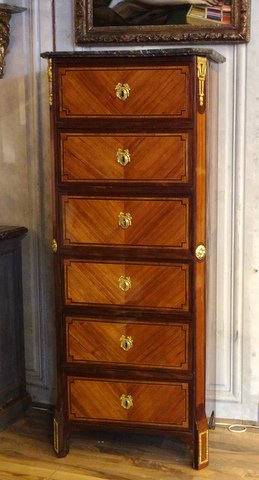

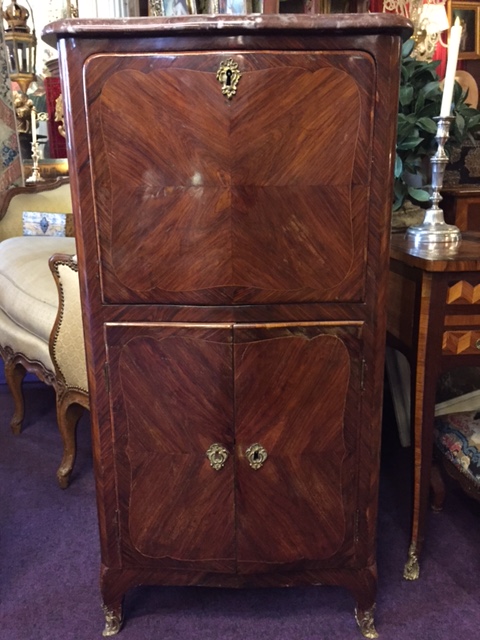
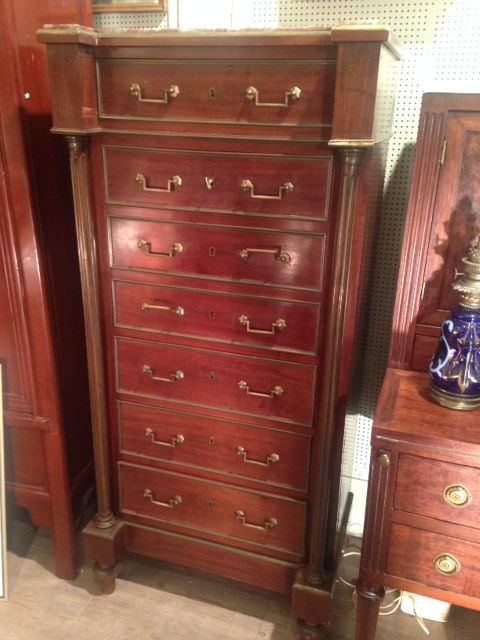
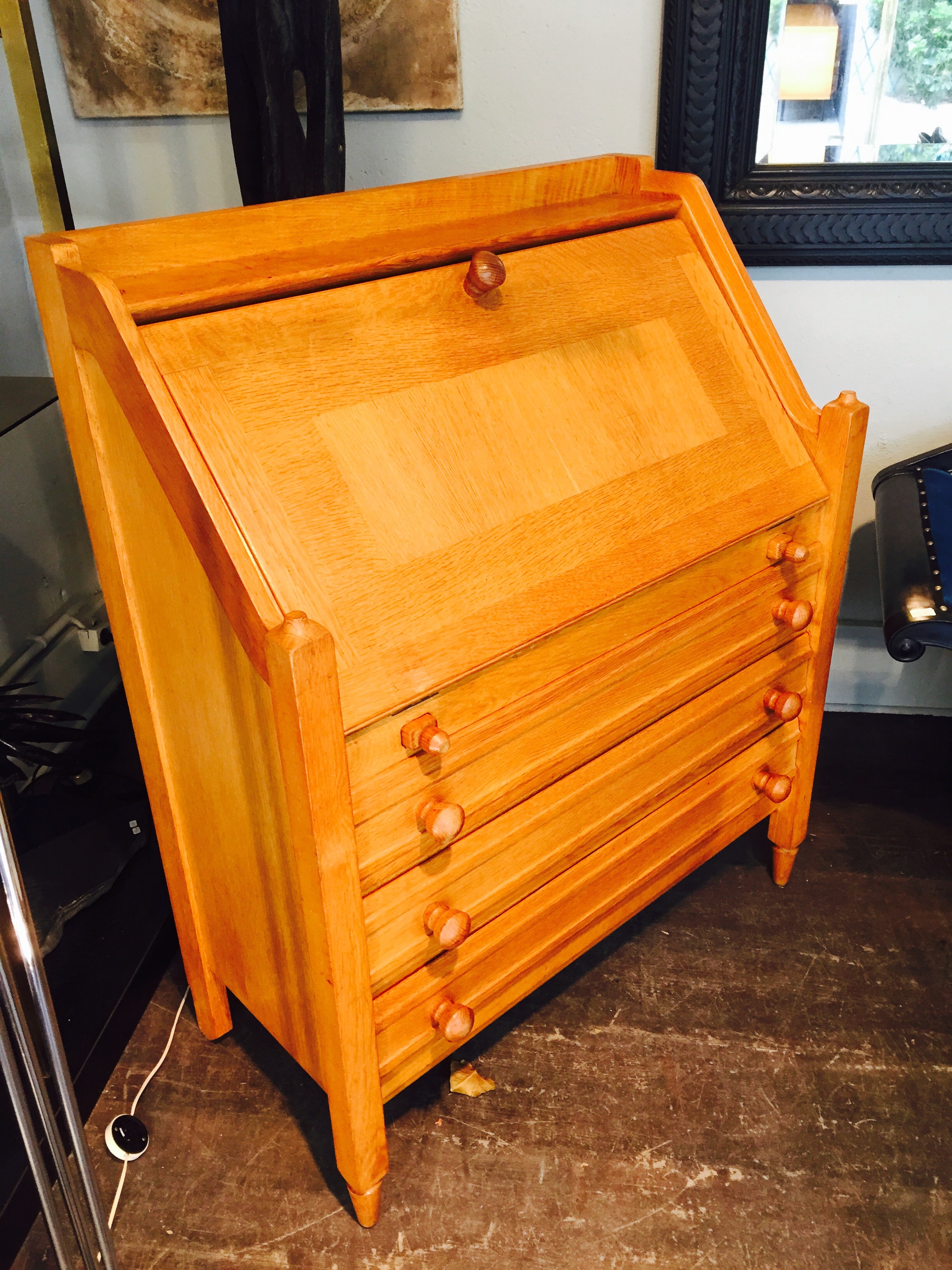
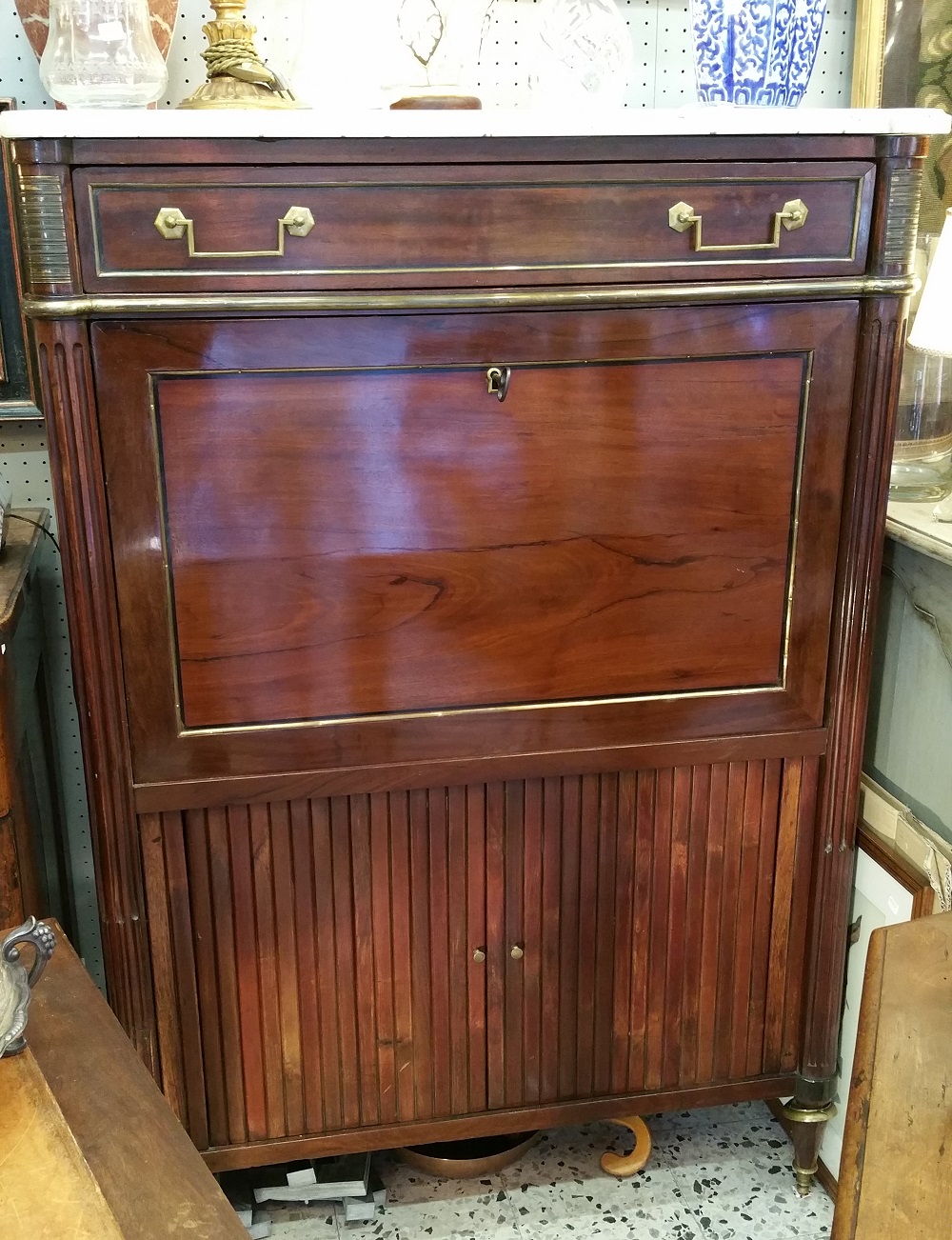
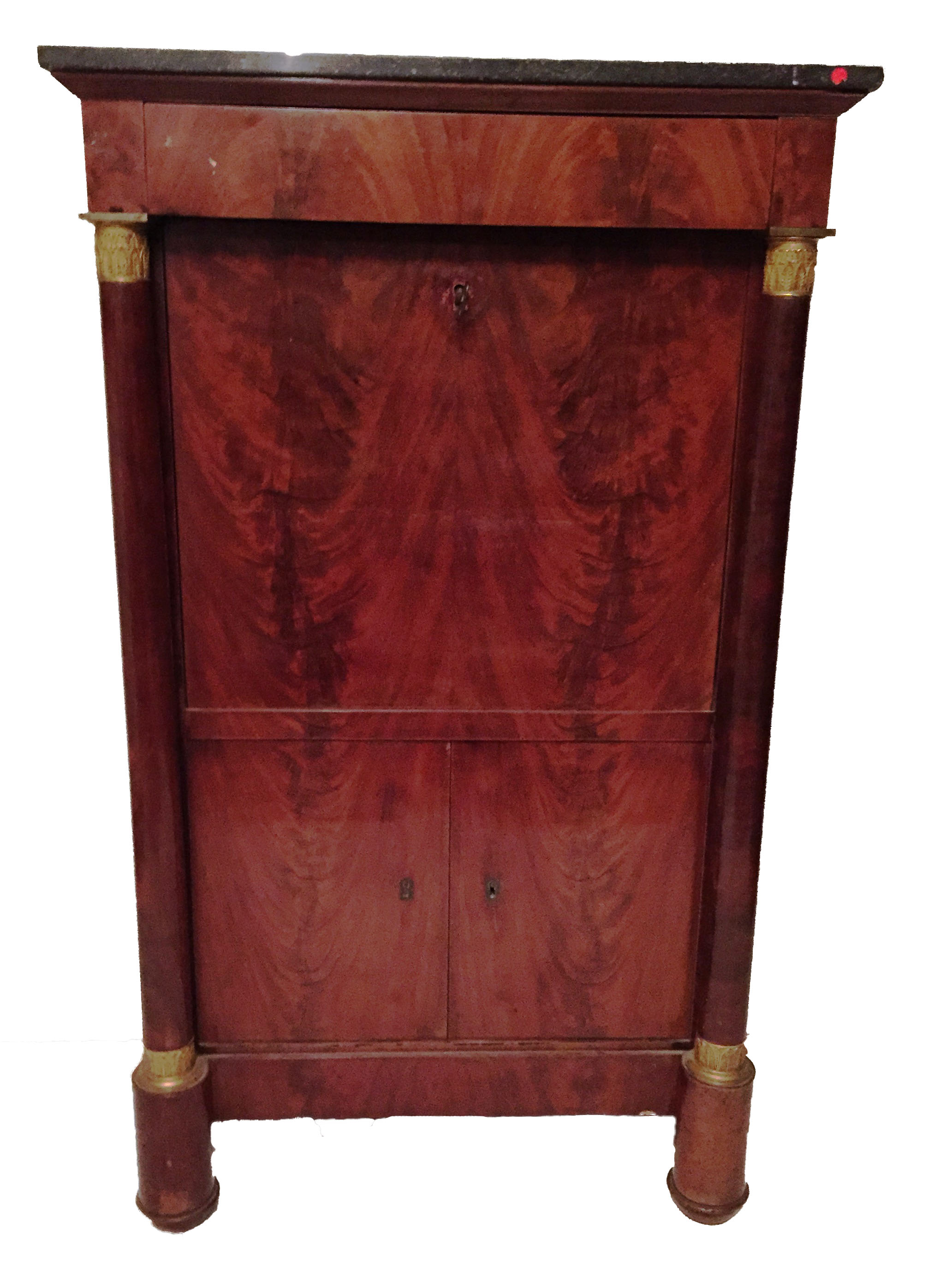
Let us reacquaint you with a small piece of furniture which has known how to survive the centuries and is still in use today. Whether it be a piece in the Louis XV style or by a post-war designer, the secrétaire desk can be found here at Paul Bert Serpette in shops selling classic antiques and those selling 20th century design. A history and adaptability which make this piece, a very close cousin of the standard desk, an unusual piece of furniture which is timeless.
It is a hybrid, a mix of writing desk and set of drawers. Upright and closed it is discreet. It is only when you open it, dropping the front leaf which becomes the work surface, that you have access to all its drawers and cubbyholes. The key to the piece is central – without it you cannot open it. Secrecy is at the heart of the secrétaire, surely the reason for the name.
The story goes that the first was ordered by Louis XV from his cabinetmaker Oeben in 1760. It was a work of mammoth proportions, taking nine years and finished under the reign of Louis XVI by Riesener, Oeben having died in the meantime. The clever point about this roll-top desk was that it could be locked completely. In the absence of the king servants could replace ink and paper using two specially designed slots. Fourteen different types of craftsmen worked on the piece from those who worked with bronze to those who worked gold. It was a piece which was paradoxical – the ostentation of its raw materials and the techniques used in the service of keeping state secrets secret.
Confidentiality was, therefore, at the heart of the secrétaire, or drop-down desk, which appeared part way through the 18th century, the golden age of correspondence and the art of letter-writing. Remember the first letter written by the naîve Cécile in ‘Dangerous Liaisons’ when she writes to her friend “I have my own maid, a bedroom and closet to myself, and am sitting as I write at the prettiest desk to which I have been given the key so that I can lock away whatever I wish”.
The secrétaire goes hand in hand with a feminization of taste under the aegis of Mme de Pompadour, the king’s mistress. The pomp of Louis XIV disappears and is replaced by a time where life is lived more in private. Furniture becomes smaller, more discreet and is better adapted to rooms such as the boudoir or the study.
The drop-down desk becomes part of every bourgeois house or apartment. After the war it becomes even more common-place and is no longer only found in the homes of the rich. Reinvented by the designers of the UAM it is no longer made from exotic woods or inlaid with precious materials, rather more humble materials are used such as oak and the form is simplified making mass production possible. Some, such as Guillerme and Chambrom, keep the traditional form of the desk preserving the lower half. Others like Marcel Gascoin take a more radical approach and remove it completely, preferring a desktop fixed to the wall. The desk becomes adaptable, a piece of furniture bought for a child which can follow him or her into adulthood. The lock disappears as in the 1950s the efficient utilization of limited space rather than secrecy is the key. Modern living conditions are cramped and every square meter must be made the most of. Rather than a classic desk, a drop-down desk or secrétaire is preffered as once closed it takes up less space.
From the 18th century aristocracy to post-war working families, the design and discretion of the secrétaire has made it a witness of over 250 years of history.