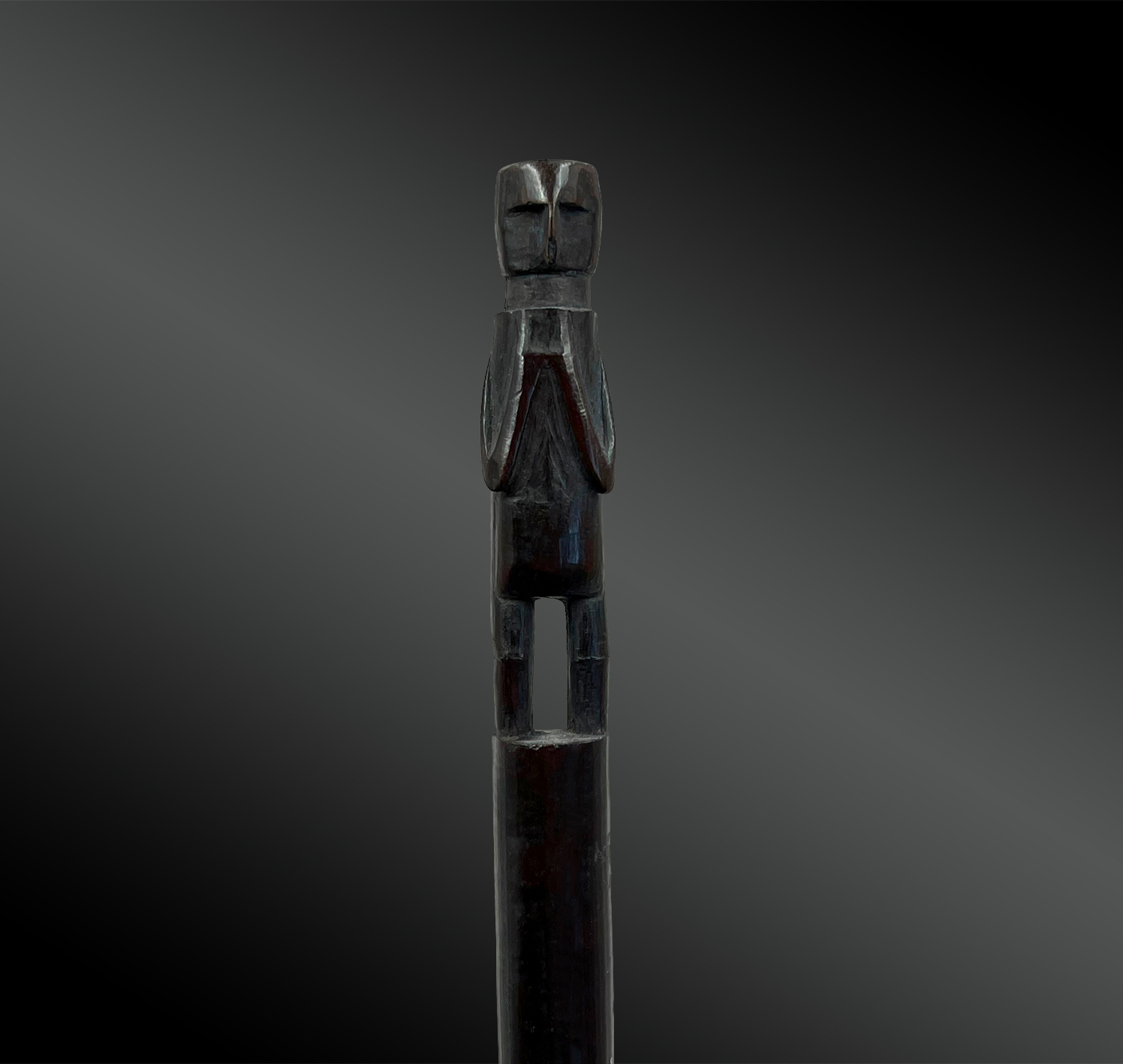


SHAMAN'S STICK
Emberá Culture, Chocó, Northwest Colombia
First half of the 20th century
Drink
H.: 70.5; L.: 2 cm
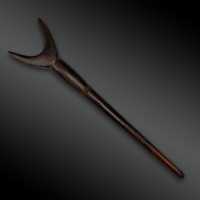
This wooden staff with red patina, carved on the upper part of a stylized anthropomorphic figure, standing, was an object carrying a particular power.
Indeed, according to the anthropologist Erland Nordenskiöld, charged with beneficent spirits, these sticks "help the medicine man to drive out demons".
The so-called “medicine man” refers to the jaïbaná : the shaman among the Emberá Indians.
This individual - who could be a man or a woman, took on a primordial role in society: he was both the healer , the healer, but also the intermediary, the physical link between man and spirituality, between the visible world and the invisible world.
He alone had access to the jaï , the spirits.
The tradition wanted the future shaman, trained by an elder, to carve his first staff himself. When he had attained the status of jaïbaná , he was offered a second stick. A shaman could thus accumulate a large number of sticks throughout his life.
Three introductory facts are reported by the historian Mircea Eliade for a man to become a shaman.
It was necessary first of all to have the vocation, it is a call, an intimate inclination. It was then necessary for the initiate to inherit from a parent who was already a shaman before him. Finally, he had to be chosen by the clan. Once these three points were met, the jaibaná in the making had to explore an initiatory journey where secret languages, mythology, ecstasy, dreams and dreams were taught to him.
Text and photos © FCP CORIDON
Ref.LP: FCP


 +33681153179
 ff.coridon@wanadoo.fr
 www.proantic.com/galerie/coridon/