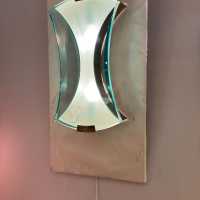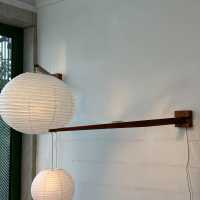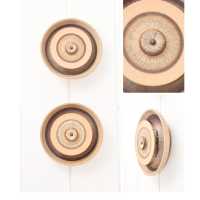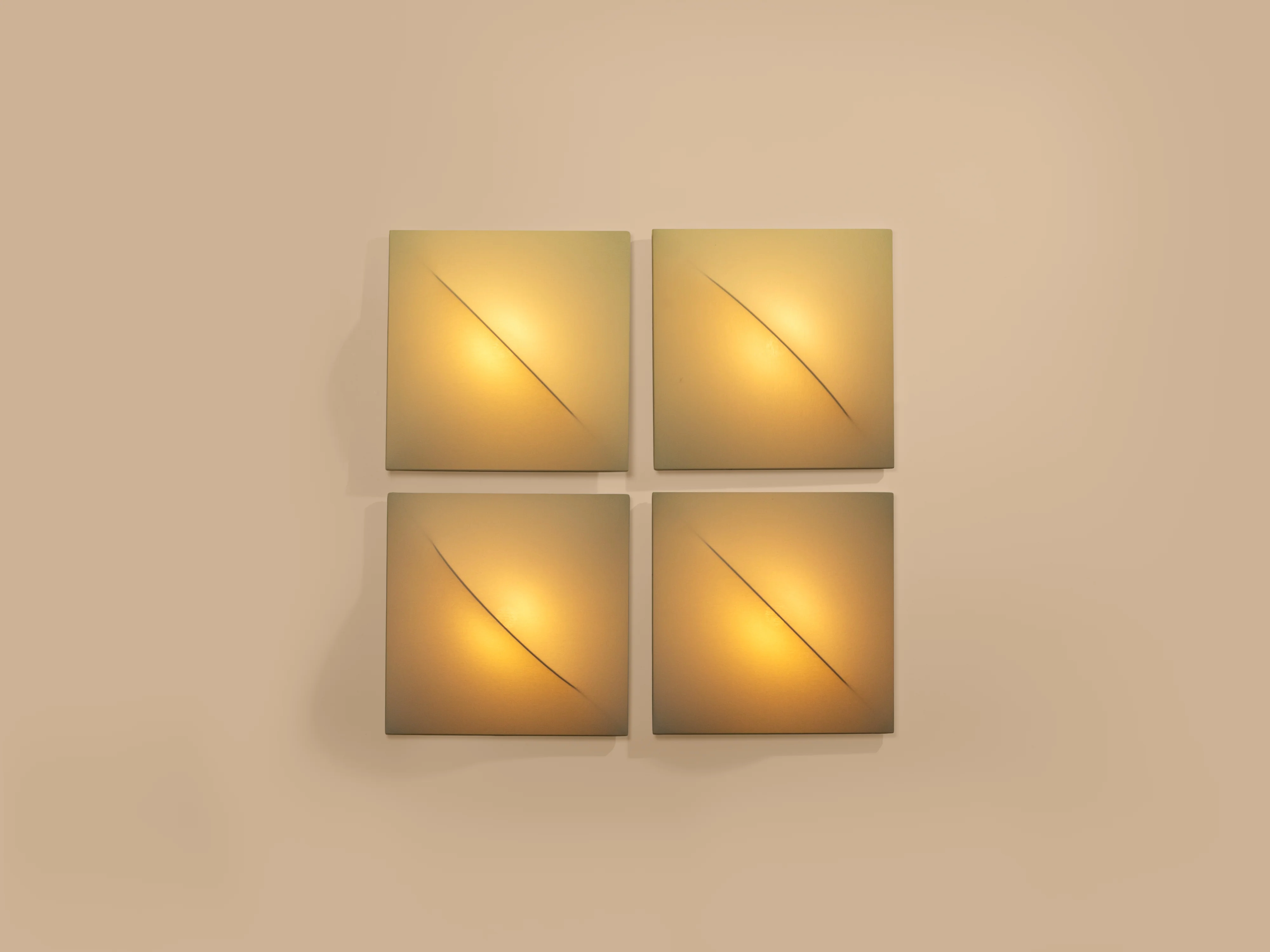
This magnificent collection of Saori wall sconces was designed in the early 1970s by Kazuhide Takahama for Sirrah edition. It perfectly illustrates Japanese minimalism, combining geometric precision with a poetic approach to space. Each sconce consists of a square, white-painted metal frame covered with a stretched white fabric that softens the light, giving the lamps a diffuse and enveloping presence. Inspired by traditional Japanese washi paper screens and shōji, the design allows natural light to filter through, evoking the atmosphere of traditional interiors. The fabric intentionally features subtle folds, echoing the origin of the name Saori, which refers to a free-form Japanese weaving technique that prioritizes freedom of movement, intuition, and expression. This choice reveals the designer's desire to conceive of the sconce not as a static object, but as a living surface where light interacts with the material. It is precisely in this dialogue between geometric rigor and the inherent irregularities of the material that the beauty of Takahama's work resides. This model can be used as both a wall sconce and a ceiling light, offering great freedom of use and versatility.
We have six pieces in stock, all fully restored, the fabric has been replaced with the same off-white stretch fabric, the wiring has been redone and they are ready to use.
Kazuhide Takahama (1930–2010) was a Japanese architect and designer. Trained in architecture and design at the Tokyo Institute of Technology, he developed within a context marked by postwar reconstruction and a profound reflection on function, simplicity, and the standardization of forms. He first gained recognition at the 1957 Milan Triennale, where he designed the Japanese Pavilion, an event that proved a turning point in his career. It was there that he met Dino Gavina, beginning a long collaboration. After settling in Bologna in 1963, Takahama worked throughout the 1960s and 1970s for Gavina, as well as for other major Italian publishers such as Sirrah and B&B Italia. He developed a unique stylistic language, combining the codes of Western modernism with a poetic minimalism deeply rooted in Japanese culture. His work extended beyond furniture and lighting to include architectural projects and interior design. Through his creations, Takahama explored the balance between light, material, and form, imbuing each object with a presence that was both functional and contemplative. He is now recognized as a major figure in international design, having reinterpreted the legacy of Western modernism through a Japanese sensibility characterized by rigor, clarity, and restraint.
Dimensions:
Width: 62 cm
Depth: 20 cm
Height: 62 cm
For more images: maisoncedric.com
Art direction: @adelemeunier


 +33 (0)6 24 55 52 51
 cedric@maisoncedric.com
 maisoncedric.com/fr