THE FINDING OF A LIFE.
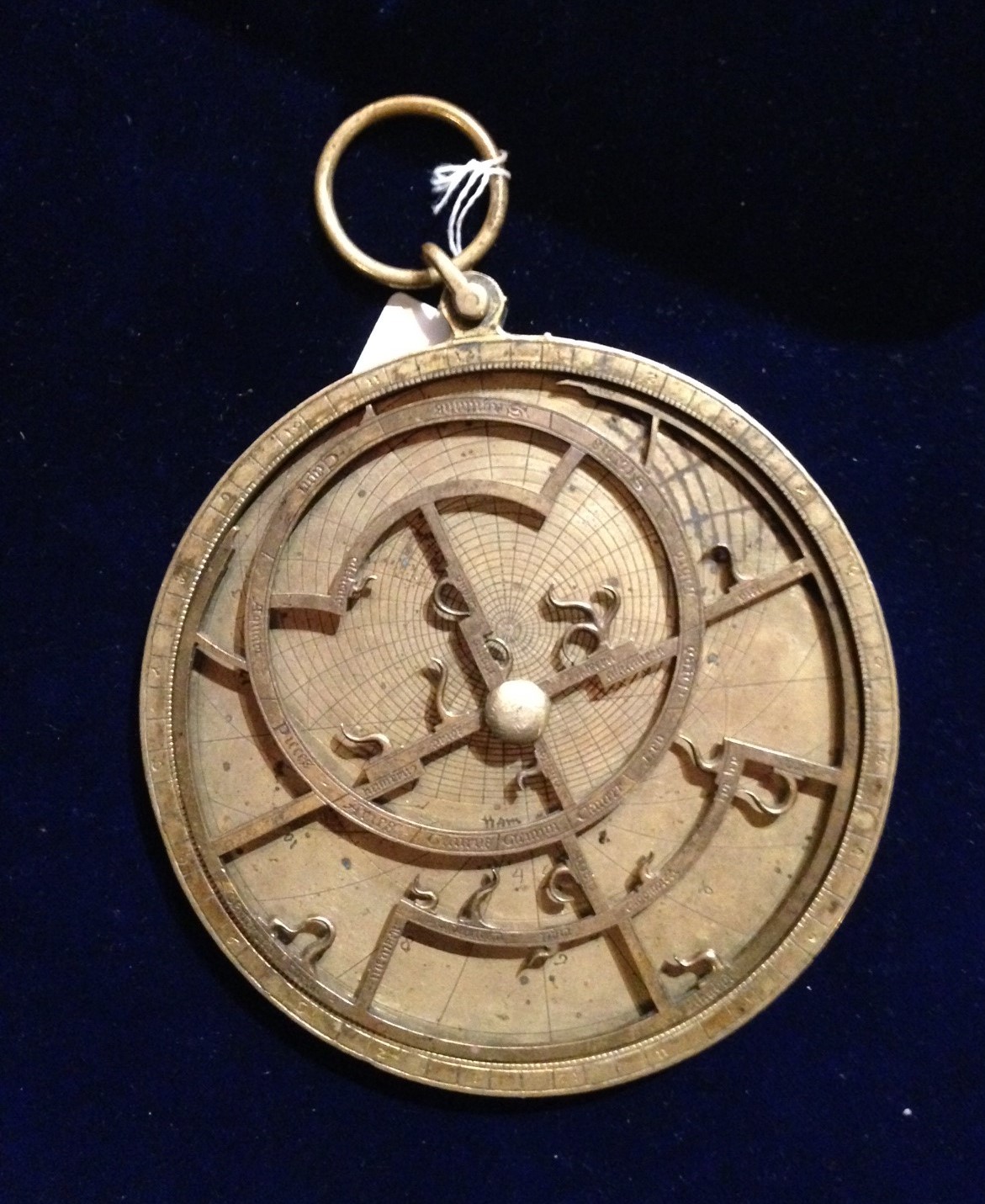
The delicate and precautionary gestures of Jean Delmas, an antiquary to Serpette, testify to the great age of this object but also to its rarity ... There are only ten in the world. You can admire it at the Museum of Arts and Crafts in Paris or Oxford but in a market, it is unheard of. Jean Delmas has only seen one in his long career as an antiquarian and it is this one. In other words, he keeps it preciously.
STRANGE INSTRUMENT
Round shape, flat, it holds in the hand. Its gilded surface is covered with Gothic inscriptions that are indecipherable for the common hunters. Curves, straight lines squared it according to a mysterious order. At its center, a structure of circles and arabesques moves to indicate to the initiate a secret code. Worthy of a film by Indiana Jones or a novel by Dan Brown, this intriguing object tickles the imagination and gives rise to the wildest speculation. "Astrolabe" discreetly whispers Jean Delmas. In his booth where the tictac of the clocks of another time reigns, it is he who keeps the secret of this enigmatic object.
STAR WARS IN THE MIDDLE AGE
Appear in ancient Greece, the astrolabe is the nocturnal counterpart of the sundial. The result of scientific calculations, it allows to know the positioning of the stars, to calculate the height of the stars and from there, to read the time. Used for astronomy and astrology, the astrolabe can only be used in the place for which it was designed, the map of the sky varying according to latitude. On the representation of the celestial sphere, the spider turns symbolizing the stars and the sun. On the back, the civil calendar, the square of the shadows and the signs of the Zodiac make it possible to find oneself according to the day. Progressively ousted by the rise of watchmaking, the astrolabe is the distant ancestor of GPS.
UNDER THE SKY OF PARIS
Very popular with Arab mathematicians and astronomers, the astrolabe in France enjoyed a period of splendor at the end of the Middle Ages. Jean Fusoris, physician, ecclesiastic and scientist, creator of the astronomical clock of the cathedral of Bourges, made it his Parisian business. Born in 1365, during the War of 100 years, this son of potter learns to melt the tin with his father. It derives its name from the Latin fusor, founder. Assembled in Paris, he opened his shop of portable sundials and other measuring instruments. Author of a Treatise and use of the astrolabe, dedicated to Peter of Navarre, Fusoris signs his creations by his "spiders" recognizable among all. It is thanks to her that this astrolabe can be attributed to her. To this is added the inscription "Paris" which confirms that the instrument was designed for a Parisian use. Disappeared around 1436, Jean Fusoris had certainly not imagined that his astrolabe would still be on sale, under the sky of Paris, more than 500 years later ... http://paulbert-serpette.com/antiquaires/jean-delmas/