What are the main events of the twentieth century if not an image? A unique image that crystallizes a complex reality. The Afghan conflict in the immense green eyes of the red-veiled girl immortalized by Steve McCurry. The famine in Sudan in the curled little girl scrutinized by a vulture and captured by the goal of Kevin Carter. "On thousands of photos taken, we always remember one," Regis Besse from the Galerie Verdeau, alley 6 at Paul Bert.
The girl in the picture.
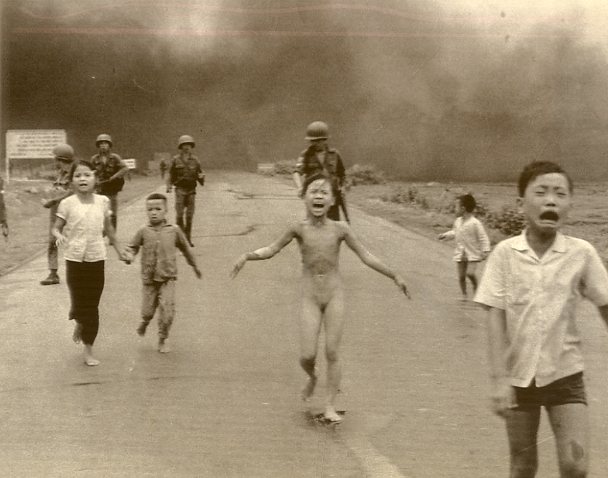
This picture has been around the world, illustrated with thousands of articles and books, until they become part of the collective unconscious. Take the test, ask someone what image he associates with the Vietnam War. Undoubtedly, he will see a naked little girl, arms crossed, face distorted by pain and running straight towards him. This child is Phan Thi Kim Phuc. On June 8, 1972, in Trang Bang, a village in South Vietnam, she was nine years old and had just been burned to napalm in a bombardment. Surrounded by her cousins, she runs to the photographer, Nick Hut, a young man of 21 years sent by the Associated Press cover this conflict where the Americans bogged down. He replaces his brother, photographer in the same agency, died in a bombing. By triggering his camera, he certainly does not imagine the impact and the scope that this shot will have.
From framing to manipulation
Taken on June 8, 1972, Nick Hut's photo is only published on June 12 in the New York Times. Receiving the shot takes time, of course, but that's not all. At the editorial office, we procrastinate, we wonder and finally modify the cliché. First we reframe it. Much of the right side of Nick Hut's photo is removed. The soldiers, indifferent to the fate of the children, are thus erased. Well centered, the little girl becomes the axis of a more rigorous, symmetrical, almost classical composition. The arms cross, Christ figure, the body of the child is also "regouaché". Its contours are accentuated so that it is better distinguished from the road on which it runs, in this cliché in black in white. The question of nudity is also posed. Can a naked girl be shown in a newspaper? The answer is not long in coming. Sex is blurred, as evidenced by the draw of Régis Besse.
A historical impression
These little arrangements with reality do not end there. The New York Times article never explains that on June 8, 1972, it was South Vietnam's forces who bombed their own camp to eliminate dissidents. Phan Thi Kim Phuc is presented as the victim of the American bombing. Symbol of the stupidity of a blind war whose children are the first victims. When it was published, public opinion was moved. Richard Nixon cries for manipulation but he is quickly overtaken by the Watergate scandal. Mobilization accelerated and American troops withdrew a year later. From that to say that a cliché has precipitated the withdrawal of the Americans ... It is in any case the witness of a reversal of events and a proof of the non-objectivity of the images, always biased treatment of the reality. From 1972 to 2014, this little cliché, no bigger than a postcard, where the newspaper stamp is affixed to its first issue, passed between so many hands, aroused so much emotion and reaction, that its weight History today is immeasurable.