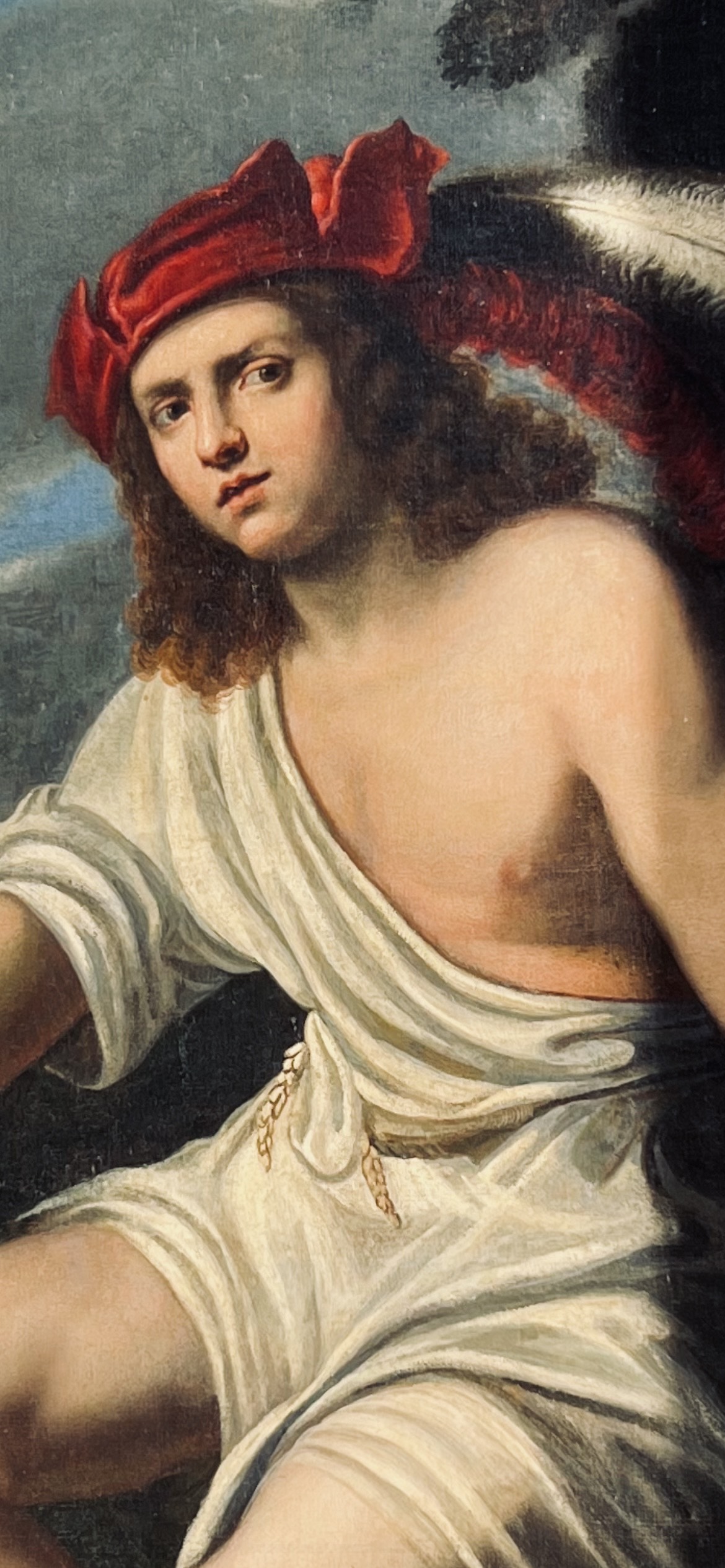
Thomas Rey unveils a striking work by Cesare Gennari: David with the Head of Goliath. Rarely exhibited, this Baroque painting captivates with both its dramatic power and the subtlety of its execution. In this biblical scene, Gennari — nephew of the renowned Guercino — contrasts David’s youthful triumph with the mute brutality of the fallen giant, all rendered in a tense, almost theatrical atmosphere. With this selection, Thomas Rey continues his exploration of a sensitive, intense Baroque, where painting becomes both narrative and revelation.
Cesare Gennari is a 17th-century Italian painter, representative of the Bolognese school and direct heir to the style of his uncle, Guercino (Giovanni Francesco Barbieri).
Born in Cento in 1637, Cesare Gennari was the son of Ercole Gennari and Lucia Barbieri, sister of Guercino. Upon Guercino's death in 1666, Cesare and his brother Benedetto inherited his studio and property, thus perpetuating his style and fame.
Cesare Gennari embodies the transition between the dramatic Baroque of Guercino and a more elegant and academic painting, thus marking an important stage in the evolution of Bolognese painting and this is what we find in this unpublished composition of a subject so dear and so represented by his master Guercino.
The Bologna school, influenced by the Carracci, advocated a return to classicism, harmonious compositions, and balanced forms. Cesare Gennari adopts and extends this style in this painting with a dramatic and balanced composition (not without a dynamism inherited from chiaroscuro) but with particular attention to the expression and gestures of the character.
Here, David is not in motion or exalted as in the previous works but the dynamism of the composition lies in the static character of the hero who poses seated while scrutinizing the spectator, calm and serene while holding the head of Goliath in his young hand and in the other a gigantic, almost legendary sword of justice which allows the composition to deliver different symbols, allegories and interpretations to the spectator thus inviting him to reflect.
The research and study of this large painting highlights that to date, there are no known preparatory drawings, engravings or paintings whose composition would be very inspired or even taken in its entirety; it is a truly large unpublished composition and not a direct replication of his master by Cesare.
In addition, the significant dimension of the painting and its verticality offers the reflection of this image a striking, powerful and timeless presence to the one who contemplates it.